


WASHINGTON — On Monday, August 17, the Department of Justice Office of Public Affairs announced a final rule that will allow “eligible individuals” who have lost their rights to apply for restoration of their federal firearm rights, with the new process relevant to almost 10% of the entire American population.
“The Second Amendment is not a second-class right, and the federal government should not permanently deprive Americans of a constitutional right without regard to whether they pose a danger to public safety,” said Attorney General Todd Blanche in the related press release. “This rule establishes a rigorous, commonsense process that protects the public while giving deserving Americans a real path to restoration.”

This final rule will take effect 30 days after publication in the Federal Register, at which time the DOJ will invite candidates to apply (there’s no explanation for how the DOJ will identify these candidates). The first applications open to the public will occur 75 days after the publication, available for up to 5,000 candidates, and 120 days after, 500 additional candidates can apply, and application fees will begin, according to the new DOJ website.
Yes, the application to restore rights comes with a modest fee, an insult that won’t be lost on the millions of Americans who are fighting increasing fee creep as a result of governments infringing upon Second Amendment rights. Nonetheless, the $30 fee is not likely to be a barrier for those who have had their 2A rights revoked for decades or more, and applicants can request a waiver or reduction of the fee.
For more than 30 years, since roughly 1992, the pathway for restoration of gun rights existed on paper but was never meaningfully exercised because Congress added appropriation riders that banned the ATF from spending federal money to set up or administer the process.
The new 144-page rule gets around the congressional blockage by moving the function back to the attorney general’s office (it was previously delegated to the ATF, which historically was fully aligned with Congress’s anti-rights agenda), and in a little bit of clever loophole politics, assuring Congress that everything is kosher:
Because this final rule 17 would not involve ATF personnel or resources in the processing of relief applications, the rule is consistent with the rider’s stated purpose of preserving ATF resources.
The ATF first proposed this rule in July of last year, under the Bondi DOJ, at which time the agency at least nodded its head to President Trump’s executive order on protecting the Second Amendment, signed in February of 2025. It’s notable that the rule and process itself came out under the Blanche DOJ, which has also been responsible for the ATF’s historic 34-rule reform package, earlier this year in April.
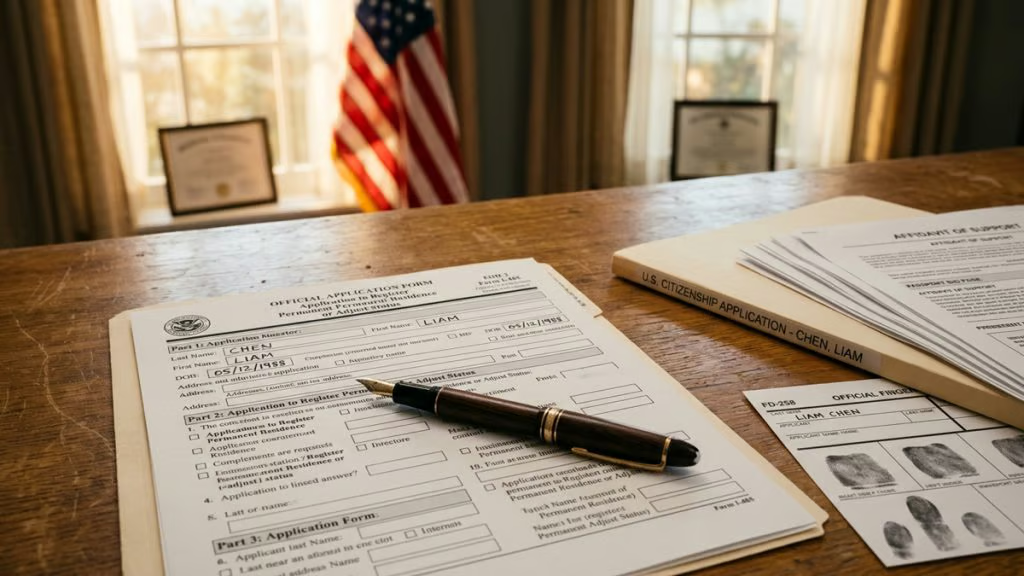
The application process and required supporting documentation are substantial, and include a long list, including three character references that are not related by blood or marriage, along with fingerprints, a list of prohibitions, mental health records, court discharge orders, military records, and more.
No doubt, gun control groups will issue drama-laden statements declaring that millions of criminals are about to be armed, but as the DOJ’s press release notes, “restoration of firearm rights is neither automatic nor guaranteed.”
The DOJ goes on to clarify that, “Absent extraordinary circumstances, violent felons, registered sex offenders, illegal aliens, and other individuals who present an ongoing danger will remain presumptively ineligible for relief.”
Indeed, the offered relief is also contingent on a certain amount of time having passed from conviction, with the DOJ theorizing that “The particular time-limited presumptions identified in the final rule are calibrated to the nature of the relevant offenses and the likelihood for recidivism…”
There will be a required 10-year waiting period for convictions of:
- Drug trafficking felonies
- Threats of violence
- Explosives offenses
- Certain firearms-related offenses under federal law
- Possessing or discharging a firearm or weapon on school property
- Animal abuse
- Misdemeanor crimes of domestic violence
A five-year waiting period will be required for:
- Any other felony (not already listed above)
- Assault, battery, stalking, or any threatened act of violence
There is also a long list of current or ongoing disqualifiers that include awaiting sentencing or currently serving time and being an unlawful user of or addicted to a controlled substance.
This announcement is historical in that for the first time in 30 years, Americans who have been deprived of this specific constitutional right will have an opportunity to apply for relief. Of course, it’s worth noting that this rule can simply be reversed by a future anti-gun administration, and there may be multi-year delays as applicants await what will likely be a lengthy process if millions of people apply.

















The 925(c) will be the easy part compared to getting your respective state to agree.