

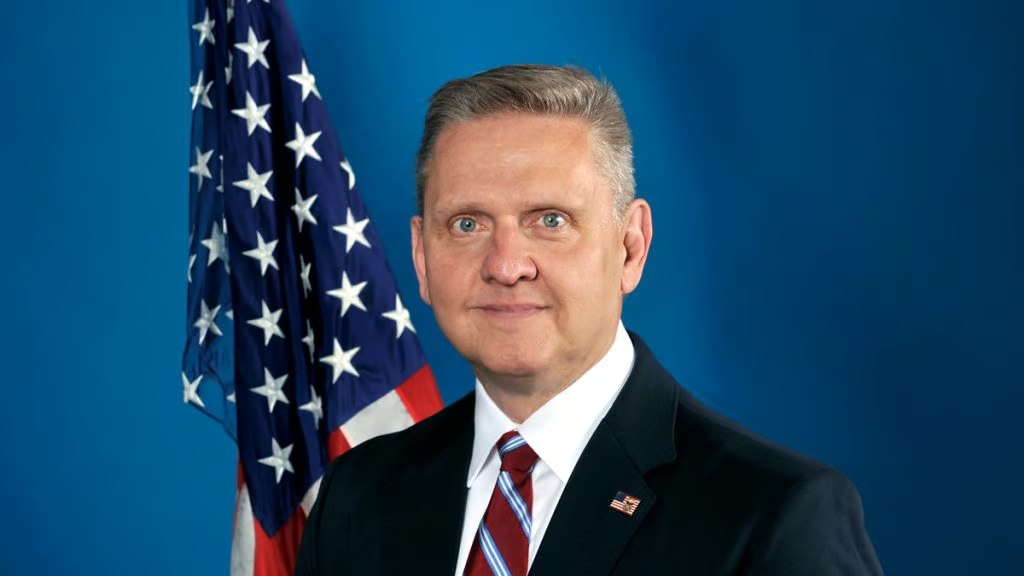
On Wednesday, April 29, Acting Attorney General Todd Blanche announced at the start of a scheduled press conference that the Senate had confirmed Robert Cekada as the new Director of the ATF. After a brief statement, Cekada signed what was described as “the most comprehensive regulatory reform package in the history of the ATF.”

Blanche introduced the reform package by describing the intent of the agency as it relates to President Trump’s February 2025 executive order to protect the Second Amendment:
“We’re repealing rules that went beyond what the law allows; we are cutting unnecessary red tape; and we are replacing confusion with clear, straightforward language so that everyday Americans don’t need a law degree just to understand their rights…”
“And this did not happen in a vacuum. We listened to industry leaders… to legal experts, and most importantly, to law-abiding gun owners across this country – people who follow the rules but have been forced to navigate a system that often didn’t make sense.”
“For too long regulations were written without any real understanding of how firearms businesses operate, how lawful gun owners actually handle their firearms, or what truly improves public safety.”
“This package also brings into line ATF regulations with the law and with Supreme Court precedent.”
“The work that we’re talking about today is not finished today. We’re continuing to review every regulation, especially those from the previous administration and will keep putting forward additional proposals as that review continues.”
Blanche closed with a statement that was concerning and seemed out of context with his earlier comments, stating, “For example, ATF is studying right now to determine which rifles are generally recognized as ‘particularly suitable for sporting purposes.'”
Cekada stated the ATF undertook a year-long review that included researching court decisions, license feedback, statutory texts, forms, and requirements, and stakeholder feedback in order to identify regulations that needed reform.
“In today’s package, you will see 34 clear, common-sense regulations that rescind, modernize, or clarify language within the National Firearms Act, the Gun Control Act, and more,” stated Cekada.
The reform package includes 34 proposed rules categorized into five groups:
Cekada highlighted some key issues of national concern to gun owners during the press conference. The ATF is proposing to rescind both the Biden-era stabilizing brace rule and the “engaged in the business” rule.
They are also proposing to modernize and update key forms (including Form 4473), and to allow FFLs “to generate and store records… using electronic record-keeping systems.” Electronic record-keeping is a thorny issue for gun owners who argue that it makes creating a national registry far easier.
Over the course of the next few weeks, the ATF plans to hold stakeholder meetings in smaller, more focused groups to “dive deep into the regulations that will affect each of you the most.”
Summaries of the proposals are linked above and will be published to the Federal Register, where they will be available for public comment.
Gun owners are well aware that infringements on the Second Amendment dramatically increased under the Biden administration because of its own package of rules. Ensuing court cases have often found that those “rules” do not carry the power of law, though they can cause significant infringements and legal issues for gun owners during the challenge phase. Although the ATF may have the best of intentions of repealing those infringements, the effort sets up an inevitable pendulum effect that will continue to swing more wildly from administration to administration.
Robert Cekada’s Career and Background
Cekada began his law enforcement career with the New York City Police Department in 1992, was promoted to detective, and then moved to work in patrol and SWAT in Broward County, Florida. In 2005, he joined the ATF as a special agent in the Baltimore Field Division, working on organized crime and gang-related activities. He worked his way up through the ATF ranks and on April 10, 2025, was named Deputy Director of the ATF.