


ALBANY, N.Y. — On September 30, District Court Judge Glenn T. Suddaby issued a judgment offering a very narrow victory for gun owners against New York’s Concealed Carry Improvement Act (CCIA) while leaving large portions of the statute’s sensitive places bans in place.
The Antonyuk v. James case, out of the United States District Court for the Northern District of New York, challenged the July 2022 CCIA that dealt with firearms licensing, sensitive locations, and restricted locations (along with carrying on private property open to the public). This case is a perfect example of how Second Amendment challenges have the possibility to stretch out over half a decade or more, especially when the Supreme Court doesn’t hear a case on the merits and trusts a lower court to faithfully execute a decision in a case that is remanded.

A brief procedural history is in order. Judge Suddaby blocked large portions of the law in November of 2022. On appeal, the Second Circuit Court of Appeals functionally restored the measure. The challenge reached the Supreme Court in July of 2024.
The Supreme Court vacated the Second Circuit judgment (see related article here) and sent the case back to the Second Circuit for a do-over in light of its Rahimi decision. Unbelievably, and to the dismay of many in the legal community, the Second Circuit returned an almost identical ruling in October of 2024, and then sent it back to the district court on remand.
Judge Suddaby’s 54-page decision begins with a striking acknowledgement:
At the outset, the Court must candidly acknowledge that it is conceivable or even likely that certain rulings of the Second Circuit in Antonyuk II may be overruled by the Supreme Court based on its intervening decisions (e.g., in Rahimi, Hemani, and Wolford) not simply for the reasons proffered by Plaintiffs but for three other reasons.
He goes on to add that:
…it is difficult for the Court to logically conclude that the CCIA is complying with the Supreme Court’s pronouncement that a state law cannot ban firearm carriage “too broadly” so that it “would eviscerate the general right to publicly carry arms for self-defense,” when the CCIA bans concealed carry in so many discrete locations that together the bans constitute a ban that exists nearly everywhere.
The judge then criticizes the state’s position on proportionality as it relates to modern analogues of historical prohibitions:
…little if any admissible record evidence has been presented that law-abiding individuals who otherwise have satisfied the requirements of receiving a concealed carry permit in New York State – including but not limited to the requirements of “good moral character,” an in-person interview, and 18 hours of in-person and “live-fire” firearm training – pose any regulation-warranting threat whatsoever to the safety and tranquility of others in the challenged locations.
For his third point, Judge Suddaby notes that “Defendants readily rely on laws from territories and/or from eras far afield of 1791 and 1868 without properly discounting their weight.”
The judge’s challenge in issuing this decision, as he states it, is “this Court must follow those rulings from Antonyuk II unless the Supreme Court’s intervening decisions so undermine those rulings that they will ‘almost inevitably’ be overruled by the Second Circuit.”
In other words, the district court must follow the Second Circuit’s decision until it is reconsidered “or is rejected by a later Supreme Court decision.”
As already noted above, the Second Circuit returned an almost identical decision after GVR from the Supreme Court, meaning it is incumbent upon the district court to also follow that decision, even if it seems incompatible with Supreme Court precedent. In essence, the district court is stuck in a legal quandary where it must follow the Second Circuit’s decision, even though that is not this court’s legal instinct.
The disappointing portion of the court’s decision is to leave in effect bans on:
- public parks
- licensed establishments where alcohol is consumed
- theaters
- zoos
With regard to challenges to private property open to the public, the court dismissed the claim without prejudice as moot after the default ban was overturned in Christian v. James and Wolford.
The court also granted the defendant’s request to dismiss claims about private property not open to the public without prejudice, which the plaintiffs did not oppose.
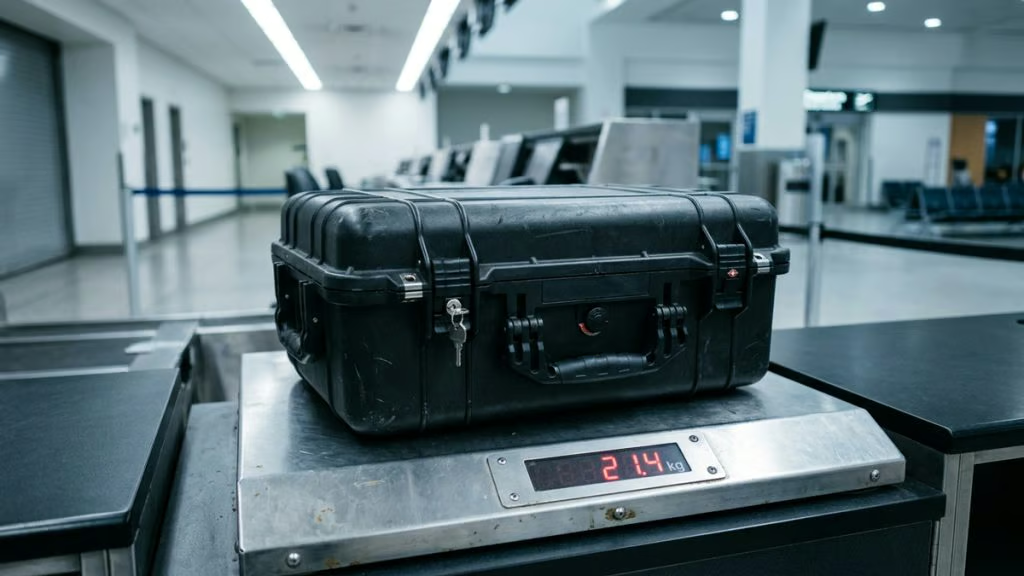
The sole highlight of the decision is the court’s issuance of a permanent injunction against the CCIA’s ban on possession in airports (as well as a denial of the state’s request for a stay of that injunction).
The CCIA’s ban covered entire airports, making it a crime – resulting in arrests and detentions – to carry a locked and secured firearm to the baggage check-in area on the unsecured side of the terminal, as federal laws require when flying with a checked firearm. Judge Suddaby declared that the state’s promise that the provision was unenforceable wasn’t enough. Plaintiffs did not ask the court to consider carrying a concealed firearm beyond the federal check-in process.
The court ordered that both parties have three days to submit letters specifying what portions of the original complaint haven’t been addressed by the order, and if no letters are received, the remainder of the complaint will be dismissed.
The Third Circuit Court of Appeals is expected to issue its decision shortly in a challenge to New Jersey’s Bruen-response bill creating large swathes of prohibited locations for concealed carry. Parties in Koons v. Davenport were invited to submit their supplementary briefs to the court in July after SCOTUS ruled in Wolford.












Join the conversation
Sign in with one click to comment under your name, or comment as a guest below.