


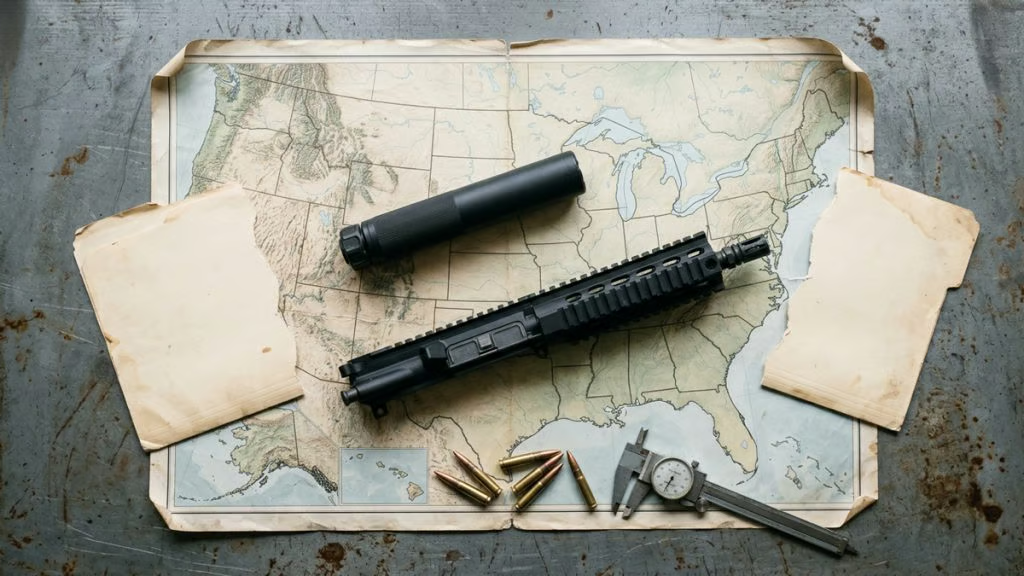
WASHINGTON — Since the ATF issued its long-awaited guidance on enforcement policy over untaxed NFA firearms on October 9, the legal landscape has in many ways become more, not less, fractured as states, federal agencies, and courts are carefully trying to find their footing.
To recap, on August 5, the United States District Court for the Northern District of Texas struck down portions of the National Firearms Act as it relates to untaxed firearms such as short-barreled rifles, short-barreled shotguns, suppressors, and any other weapons.

That court decision resulted in a permanent injunction against “…the Bureau of Alcohol, Tobacco, Firearms and Explosives, the United States Department of Justice, Todd Blanche in his official capacity, Robert Cekada in his official capacity, their divisions, bureaus, agents, officers, commissioners, employees, and anyone acting in concert or participation with them…”
That injunction’s relief was “limited to members of the plaintiff organizations,” which included numerous gun rights groups and 15 named states. The narrow injunction invited many questions about enforcement, especially over technical issues not specifically mentioned in the decision.
Then on October 9, the ATF issued guidance on how it would interpret and enforce the court decision, effectively expanding the scope of protection by stating, “…the Department will not enforce the NFA against any person as applied to the domestic manufacturing, possession, and transfer of short-barreled rifles, short-barreled shotguns, silencers, and ‘any other weapons’ (concealable firearms other than pistols and revolvers).”
“Any person” was interpreted by many legal experts to include all U.S. citizens.
Yet NFA firearms remain illegal in many states. The 15 states that are plaintiffs in the case have laws requiring compliance with the NFA registration scheme in order to allow lawful possession and transfer within the state. Gun rights groups are imploring attorneys general in those states to suspend enforcement until the legislatures can repeal those laws.
The response from states has been mixed, with some providing guidance and others remaining silent, and even some non-plaintiff states issuing their own statements. Following are the known responses from public officials in six states in chronological order.
Kansas (plaintiff)
On October 9, Kansas Attorney General Kris Kobach welcomed the ATF open letter, stating, “This is a huge victory for firearm owners. Now it’s not just Kansans who can purchase suppressors, short-barrel rifles, and short-barrel shotguns without seeking special permission from the government. It’s for citizens of all 50 states. I’m proud to say that Kansas led the way in delivering this win.”
Florida (non-plaintiff)
On October 11, the Florida state attorney serving the Eighth Judicial Circuit of Florida, Brian Kramer, clarified his office’s position on possession and “arrests, searches, and seizures based upon the possession of these items.”
State Attorney Kramer concluded, “…the absence of federal registration alone no longer establishes that an SBR or SBS is unlawfully possessed under federal law and therefore does not, standing alone, establish a violation of Section 790.221.”
That policy affects only the Eighth Judicial Circuit.
Idaho (plaintiff)
On October 12, Idaho Attorney General Raul Labrador proudly announced that residents could purchase NFA firearms.
Mississippi (non-plaintiff)
On October 12, state Attorney General Lynn Fitch announced that Form 4 is voluntary for suppressors under state law that references federal authorization. According to NRA reporting, A.G. Fitch has encouraged the legislature to pursue “clarifying language in Mississippi law to eliminate the reference to federal law during the 2027 Legislative Session,” as well as legalizing lawful concealed carry of firearms with suppressors.
Maryland (non-plaintiff)
On October 15, Maryland, a state that was not involved in the case, issued the most aggressive statement via its State Police, affirming that the state will continue to require federal registration:
The ATF’s open letter does not change Maryland’s requirements for NFA firearms. As stated in the open letter, the federal injunction and ATF enforcement policy do not affect state or local laws governing NFA firearms.
Maryland Public Safety Section 5-203 provides that a person may not possess a short-barreled rifle or short-barreled shotgun unless it “has been registered with the federal government in accordance with federal law.” The statute further provides that, in a prosecution, the defendant bears the burden of proving lawful registration.
Montana (plaintiff)
On October 19, Montana Attorney General Austin Knudsen announced that he was “working with MT Leg. Republicans on a bill to REPEAL all Montana state laws requiring ATF Form 4 tax stamps for suppressors, SBRs, and SBSs in Montana.”
Senator Galt added, “We never want to see the feds get ahead of Montana on protecting Second Amendment rights, so we’re going to axe these unnecessary regulations as fast as possible.”







Join the conversation
Sign in with one click to comment under your name, or comment as a guest below.