

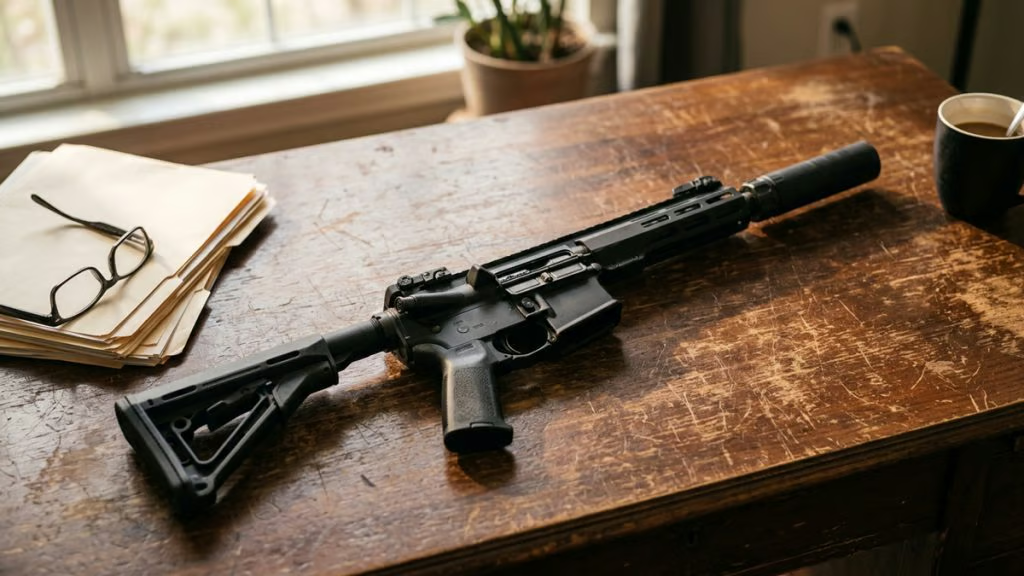
GAINESVILLE, Fla. — On Sunday, October 11, a Florida public official delivered clarification to citizens in his jurisdiction regarding navigating the recent ATF guidance on untaxed NFA firearms.
In a three-page letter to police chiefs, sheriffs, and law enforcement leadership in the Eighth Judicial Circuit of Florida, State Attorney Brian Kramer clarified his office’s position on possession and “arrests, searches, and seizures based upon the possession of these items.”

When it comes to short-barreled rifles, short-barreled shotguns, suppressors, and “any other weapons,” the current legal landscape is a treacherous quagmire where states, federal agencies, and courts are carefully trying to find their footing.
The Eighth Judicial Circuit is modest, ranking 16th out of Florida’s 20 judicial circuits and comprising only six counties with roughly 2% of the state’s population. However, the guidance from the state attorney illustrates the complicated legal landscape and is a positive sign as more jurisdictions realize the need to make public-facing statements on the subject.
Florida law prohibits possession of short-barreled rifles and short-barreled shotguns with the exception of firearms that are “lawfully owned and possessed under provisions of federal law,” which implies conformance with the ATF registration scheme that is now both enjoined by a federal court and no longer being enforced nationwide by the ATF.
State Attorney Kramer concluded, “…the absence of federal registration alone no longer establishes that an SBR or SBS is unlawfully possessed under federal law and therefore does not, standing alone, establish a violation of Section 790.221.”
In layman’s terms, he is stating that mere possession of unregistered short-barreled rifles and short-barreled shotguns is no longer by itself a crime although he is being cautious about how the office is conveying the legal landscape, given that the NFA is still law.
(Ownership of suppressors under Florida law is less complicated as the state statute on firearms possession does not prohibit possession.)
In his guidance to district law enforcement, State Attorney Kramer also concluded, “These changes also affect probable cause and the constitutional basis for searches and seizures.”
He went on to point out that mere possession is no longer the legal basis for conducting an investigation of a crime, with officers needing to add additional supporting facts showing a violation of law:
The mere possession of an SBR, SBS, or suppressor, or the inability of the possessor to produce an ATF Form 1, Form 4, tax stamp, or proof of federal registration, should not by itself be treated as evidence that a crime is being committed.
Accordingly, officers should no longer rely on the historic assumption that a short barrel or suppressor, combined with the absence of a federal tax stamp or registration paperwork, establishes unlawful possession.
Eighth Circuit officers are also being directed to contact the state attorney’s office before taking enforcement actions, “where uncertainty exists.” The memo tells officers that machine guns and destructive devices remain fully subject to the NFA and are not covered by the non-enforcement policy.
On October 12, Idaho became the first state to offer statewide guidance to citizens, with a much more relaxed legal posture. Idaho was also one of the 15 states involved in the case that precipitated these events, Silencer Shop Foundation v. ATF.
The other states that were named plaintiffs include Texas, Alaska, Georgia, Indiana, Kansas, Louisiana, Montana, North Dakota, Oklahoma, South Carolina, South Dakota, Utah, West Virginia, and Wyoming.