


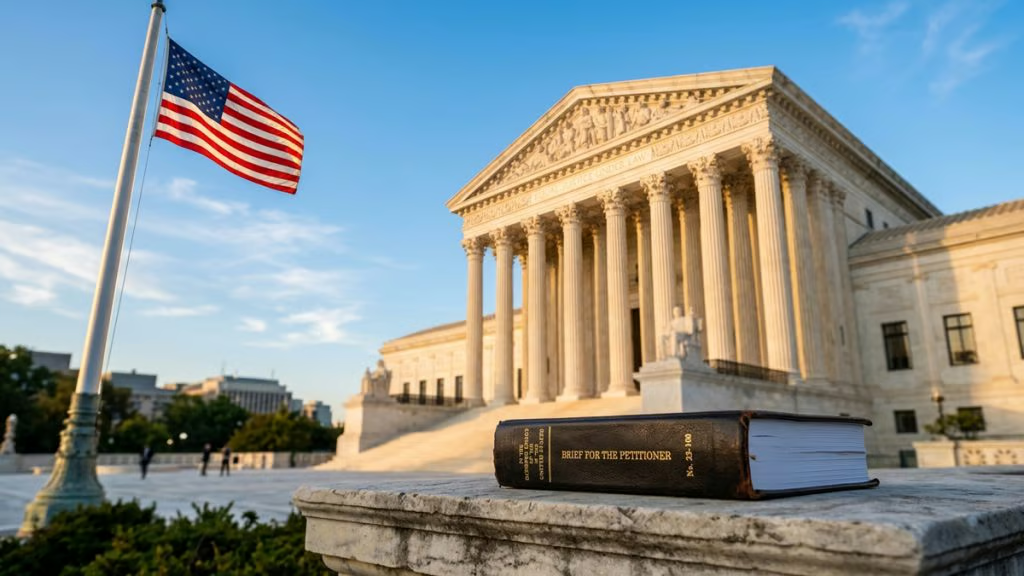
WASHINGTON — The Department of Justice is picking up steam in its mission to protect Second Amendment rights, with one of its most significant and visible actions to date being a September 4 amicus brief filed with the Supreme Court in the pending Viramontes case that will address so-called assault-weapons bans.
The 40-page brief is significant because it is the first official communication we’re aware of in which the Department of Justice sets forth its official position to the Supreme Court on the constitutionality of categorical bans on semiautomatic rifles – or, as the brief quotes, “the most popular rifle in the country.”

The brief describes the interest of the United States as follows: “The United States has a substantial interest in the preservation of the right to keep and bear arms and in the proper interpretation of the Second Amendment.”
That position comports with President Trump’s February 2025 executive order to protect the Second Amendment. The case itself is framed by a simple question presented: “Whether a categorical ban on the possession of AR-15 semiautomatic rifles infringes the right to keep and bear arms guaranteed by the Second Amendment.”
The case addresses outright AR-15 bans in Connecticut and Cook County, Illinois. The Department of Justice affirms that “Those bans are unconstitutional,” adding that “A firearms restriction comports with the Second Amendment only if it is ‘consistent with the Nation’s historical tradition of firearm regulation.'”
The brief notes that “The AR-15 rifle … is the quintessential example of an arm that is in common use among law-abiding citizens for lawful purposes.” AR-15s are lawful at the federal level and in 40 states. At least 16 million Americans – about 1 in 20 – own AR-15 rifles, and at least 28 million AR-style rifles are in domestic circulation.
Since states such as New Jersey have features-based bans, it is instructive that the Department of Justice points out that “The popularity of the AR-15 reflects its features” – a point the litigants will likely press during oral argument.
The Department of Justice rejects the argument that firearms may be banned based on supposed “military-grade” features, writing that “those courts identified no historical tradition of banning arms on that basis. To the contrary, that view is profoundly anachronistic.” It adds: “The founders would have been astonished at the claim that legislatures may ban arms in common use if those arms can also be used for military purposes.”
In drawing a distinction between the AR-15 and its military counterpart, the M16, the Department of Justice makes a notable statement about fully automatic firearms, commonly known as machine guns:
But the M16 is capable of burst or fully automatic fire, meaning that a shooter can fire multiple rounds with a single function of the trigger. … Fully automatic firearms “were never in widespread civilian use” and have “traditionally been banned” in the United States.
The statement suggests where the Department of Justice itself might come down on the topic of machine guns if pressed, though that issue is not before the court in this case.
The brief emphasizes a critical point of American jurisprudence: we do not punish the many for the actions of the few, even when those actions are criminal and destructive. To illustrate, it cites historical analogues involving Bowie knives:
And they recognized that, although “cowardly and dishonorable men” might sometimes commit crimes with weapons in common use, “the evil must be prevented by the penitentiary and gallows, and not by a general deprivation of a constitutional privilege.”
Another cogent point in the brief addresses how language is used to influence gun-control measures (a topic this publication has emphasized often):
In concluding that AR-15s are especially dangerous, courts of appeals have referred to them as “assault weapons.” “Prior to 1989, the term ‘assault weapon’ did not exist in the lexicon of firearms. It is a political term, developed by anti-gun publicists.”
The brief includes signatories across the Department of Justice, including both the Civil Division and the Civil Rights Division, which oversees the Second Amendment Section now led by Barry Arrington. You can view every DOJ legal action related to the Second Amendment in our dedicated timeline and tracker.
















Join the conversation
Sign in with one click to comment under your name, or comment as a guest below.