


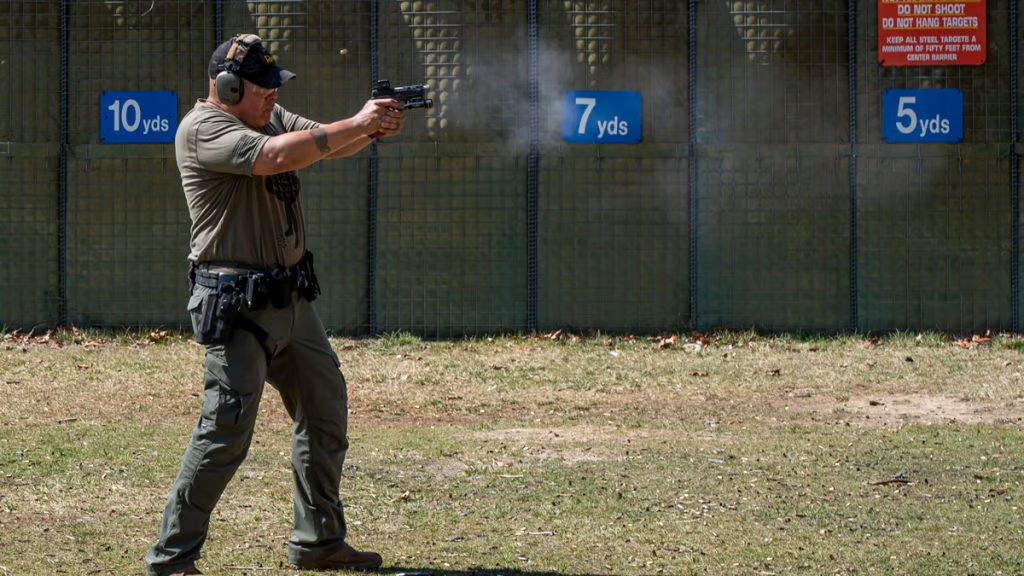
I’ve been busy balancing the many responsibilities that come with being a law enforcement and civilian firearms instructor in New Jersey. One of the most thought-provoking has been conducting CCW qualifications. After witnessing first-hand the different levels of experience and preparedness among permit holders, it has reinforced for me just how important responsible, realistic, and continued training truly is. These experiences have given me a much deeper appreciation for the responsibility that comes with carrying a firearm and the importance of being honest with ourselves about our capabilities.

Obtaining a New Jersey permit to carry a handgun is an important responsibility. It means the permit holder has met the state’s requirements and demonstrated the required level of proficiency. But as a firearms instructor, I believe permit holders need to be honest with themselves about what that qualification means, and, perhaps more importantly, what it does not mean.
Passing a qualification is not the same thing as being prepared for a defensive encounter.
New Jersey’s current concealed-carry requirements include the CCARE protocol and a required proficiency qualification. The state qualification is designed to establish a baseline of safe handling and shooting proficiency. That baseline is important, but it should be viewed as a starting point rather than the finish line.
A traditional public range can be useful for developing fundamental marksmanship. It can help a shooter establish a zero, work on grip and trigger control, confirm equipment, and maintain basic proficiency. What it generally does not provide is the uncertainty and complexity of a defensive encounter.
Most public ranges are intentionally structured around safety and predictability. You stand or sit in a designated position, face a known target, and generally know when you are going to shoot. There are few distractions, few competing priorities, and usually no consequence for taking a moment to mentally prepare before the next string of fire.
A real defensive encounter doesn’t make those accommodations.
You may be moving. You may be surprised. You may be dealing with another person, family member, employee, customer, or innocent bystander. You may have to communicate, make decisions, seek cover, disengage, or determine whether you should even access your firearm.
That is why simply becoming comfortable shooting holes in paper should never be confused with developing defensive capability.
One of the most important conversations a firearms instructor can have with a permit holder is an honest one.
Ask yourself:
What can I actually do under pressure? Can you make sound decisions when you are startled? Can you recognize when a firearm is appropriate and when it isn’t? Can you safely move around other people? Can you maintain muzzle and trigger-finger discipline while your attention is divided? Can you communicate while managing a rapidly changing situation? Can you physically defend yourself if accessing the firearm isn’t immediately possible?
And perhaps the most important question:
Can you stop yourself from making the situation worse? In New Jersey, the legal justification for using force in self-protection is tied to a reasonable belief that force is immediately necessary to protect against unlawful force. The law also places limitations on the use of force, including deadly force.
That means the responsibility doesn’t end when you decide to carry. If a defensive encounter occurs, your actions can have consequences far beyond the person you believe is threatening you.
A missed shot, an errant round, poor target identification, or an inappropriate decision to use deadly force can potentially injure an innocent person and turn one problem into several much larger problems.
The objective isn’t simply to win the gunfight. The objective is to survive the encounter without unnecessarily creating another victim.
This is where quality instruction becomes important.
Permit holders should consider training beyond the minimum qualification with a qualified instructor who can safely introduce variables that better represent the complexity of a defensive encounter. That might include movement, decision-making, communication, changing circumstances, multiple priorities, use of cover, low-light considerations, physical stress, and scenario-based decision making.
The goal isn’t to turn every civilian into a tactical operator.
The goal is to expose the student to the reality that defensive shooting is a decision-making problem first and a marksmanship problem second.
Permit-to-carry holders should recognize the importance of instructor-led training and proficiency. Certified firearms instructors should ensure applicants understand the need to be properly trained and proficient before attesting to their competence.
There is another uncomfortable truth that responsible, concealed carriers need to understand:
The firearm isn’t always the answer.
- Sometimes the best defensive tool is distance.
- Sometimes it is leaving.
- Sometimes it is verbal de-escalation.
- Sometimes it is putting a physical barrier between yourself and another person.
And sometimes, especially at close range, the most useful skill may be the ability to physically protect yourself long enough to create an opportunity to escape.
This is why I strongly believe defensive training should not consist exclusively of firearms training. Hands-on defensive tactics, physical fitness, awareness, and the ability to fight through a physical confrontation can be extremely valuable.
A person who carries a handgun should understand that there may be circumstances in which drawing the firearm is neither practical nor legally appropriate.
The Permit Is the Beginning
Carrying a handgun is a serious responsibility. The permit in your wallet establishes that you have met a legal requirement. It does not establish that you are prepared for every possible defensive encounter.
Passing a qualification demonstrates that you can meet a particular standard on a particular day, under a particular set of conditions. It doesn’t automatically demonstrate how you will perform when you are frightened, surprised, physically exhausted, distracted, or responsible for the safety of other people.
Winning a defensive encounter takes more than passing a minimum qualification and carrying a permit in your pocket.
- It takes judgment.
- It takes awareness.
- It takes physical capability.
- It takes emotional control.
- It takes decision-making.
- And it takes consistent, realistic training.
Instructors out there, our job shouldn’t be to convince permit holders that they need to become gunfighters. Our job should be to help them understand their actual capabilities and their limitations.
The responsible, concealed carrier isn’t the person who is most eager to use their firearm.
It is the person who understands when not to use it, has the skills to respond appropriately when circumstances demand action, and has trained enough to make responsible decisions when the situation is no longer predictable.
The qualification gets you the permit. The training prepares you for the responsibility.
Proper Repetitive Practice Builds Automatic Permanence!
See you on the range!








Everything is on point except the permission slip requirement. I abided by my jurisdiction’s requirements to obtain a permission slip, even taking the required CCW class. All was perfect on my end but the slip wasn’t granted. I turned that around by taking classes and it was money worth investing in, especially the last one I took with highly-trained professional. Driving is a privilege, not a right. That’s why it requires a license. Perpetuating the myth that your right to self defense requires a permission slip is harmful and it justifies government overreach and tyranny. My jurisdiction will deny those… Read more »
Great article