


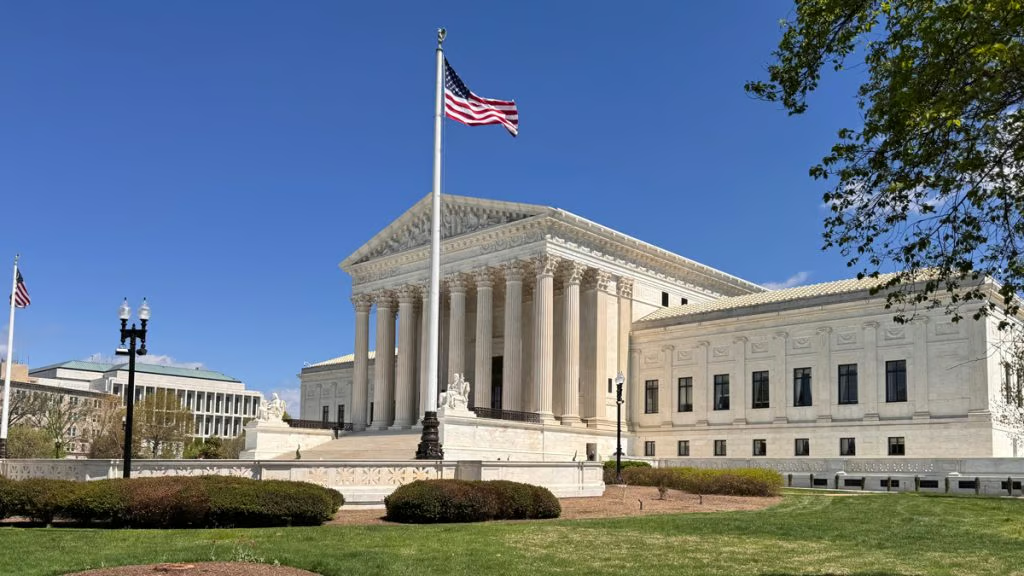
WASHINGTON — After the landmark 2022 Bruen Supreme Court decision, blue states, realizing they would have to issue concealed carry permits, rushed to enact restrictive laws to limit where firearms could be carried. States like Hawaii, in particular, attempted to shut down carrying on private property open to the public. Today, the Supreme Court struck down that effort in a significant victory for Second Amendment rights that will likely translate into changed laws across the country.
Justice Alito authored the 6-3 majority opinion, joined by Chief Justice Roberts and Justices Thomas, Gorsuch, Kavanaugh, and Amy Coney Barrett. There were two dissenting opinions. One was authored by Justice Kagan, and the other was written by Justice Ketanji Brown Jackson, joined by Justice Sotomayor. Justice Barrett also filed a concurring opinion, joined by Justices Thomas and Gorsuch.

The court reversed the Ninth Circuit’s September 2024 opinion, which had largely upheld the law after the district court enjoined it, and remanded the case.
At issue was Hawaii’s default no-carry presumption that banned firearms on private property held open to the public without the owner’s express consent. Known as the “vampire rule,” the law created a morass of restrictive regulations that would force gun owners, already vetted by the state as law-abiding individuals, to disarm and rearm throughout their day based upon arbitrary preference.
Significantly, as the Supreme Court noted, “This law flips the default rule at common law, under which anyone has an implied license to enter property held open to the public unless the property owner withdraws consent.”
The law had the intended consequences of preventing individuals from even asking if they could enter a property armed, which was noted by the court:
This arrangement imposes a new burden on permit holders who will have to somehow obtain permission to carry a firearm on the property before stepping foot on it. The law severely hampers the ability of law-abiding citizens to exercise the right Bruen recognized as they go about their daily lives.
As usual, the court applied the ruling precedent in the analysis of this case, the Bruen decision itself, which in the briefest summary requires that any gun control law must have a significant historical analogue from the founding era, and places the burden of proof on the state.
The court’s decision in this case can be summarized in one sentence: “Hawaii’s proffered historical analogues do not support the constitutionality of its new default rule.”
A significant part of the argument employed by Hawaii in this case included “particular customs and laws,” with the state raising a unique but laughable defense in which it asserted, “The spirit of Aloha clashes with a federally-mandated lifestyle that lets citizens walk around with deadly weapons during day-to-day activities.”
The Supreme Court previously chastised the state in its 2024 denial of a petition for a writ of certiorari, writing, “Had the Hawaii Supreme Court followed its duty to consider the merits of Wilson’s defense, the licensing scheme’s unconstitutionality should have been apparent. We have made clear that the Second Amendment is a right ‘guaranteed to all Americans,’ whose exercise cannot be conditioned on a showing of ‘special need.'”
In today’s decision, the Supreme Court dispensed with any and all future arguments that local customs can limit constitutional rights, writing, “The Second Amendment cannot give way to ‘the spirit of Aloha’ in Hawaii, any more than it can yield to the spirit of the Big Apple (Bruen) or the Windy City (McDonald).”
The court also addressed the rally cry raised by the Assistant Attorney General of the Civil Rights Division, Harmeet Dhillon, in virtually every amicus brief the DOJ has filed in support of the Second Amendment (including the one in this case): “The right to bear arms is not ‘a second-class right, subject to an entirely different body of rules.'”
In her concurrence, Justice Barrett noted the disparate treatment of Second Amendment issues, writing, “Consider how Hawaii and the principal dissent’s argument would play out in another context. What if a state made it a crime to wear religious head garb (say, a hijab) onto private property open to the public without obtaining express authorization? Could that statute evade constitutional scrutiny?”
In no small bit of irony, blue states, Hawaii included, have defended gun control measures in the most distasteful of ways – by raising historical analogues that were racist in nature. In this case, the state cited in its defense the 1865 Louisiana statute enacted as part of the “Black Codes” – a law designed specifically to disarm blacks.
Here, the Supreme Court strongly denounced and rejected the use of any race-based gun laws as historical analogues:
Against this history, Hawaii’s claim that this tainted artifact from Louisiana’s Black Code illuminates the original understanding of the right to keep and bear arms cannot be taken seriously. And even setting aside this statute’s pedigree, it carries no weight because it was neither widespread nor widely accepted.
Some states are already reacting to the Supreme Court’s decision in Wolford, signaling that they likely understand they will be forced to align their laws with the ruling of the highest court of the land. Earlier today, the office of the New Jersey Attorney General released this statement in response:
Today’s decision in Wolford v. Lopez is the Supreme Court’s latest dangerous blow to public safety. This badly mistaken decision will make it harder for businesses open to the public to exclude guns from their property, putting additional burdens on them to keep their patrons safe. That outcome doesn’t make anyone safer. While the Supreme Court seems intent on making it harder for states to prevent gun violence, we won’t back down from our efforts to keep the public safe. I am proud that our office’s leadership and the extraordinary coordination and enforcement efforts of New Jersey law enforcement have resulted in record-low levels of gun violence in New Jersey, and we will continue to use every tool we have to combat the gun violence epidemic.
The irony of the Attorney General’s statement is that this ruling doesn’t change anything in New Jersey regarding the carrying of arms on private property held open to the public. New Jersey’s law regarding private property was substantially the same as Hawaii’s, but has been enjoined by the federal courts for years. What this means is that the people of New Jersey have already been legally carrying concealed firearms on private property throughout the four years that have passed since the Bruen ruling. News2A has reached out to the New Jersey Attorney General’s office for comment. However, at the time of this writing we have not heard back.















New Jersey’s AG has it exactly backwards. Permit holders in NJ present no gun violence risk to a private property owner. They are not criminals because they carry firearms. She should note that the level of violent crime has plummeted in NJ since Bruen and the issuance of tens of thousands of conceal carry permits in the Garden State.