


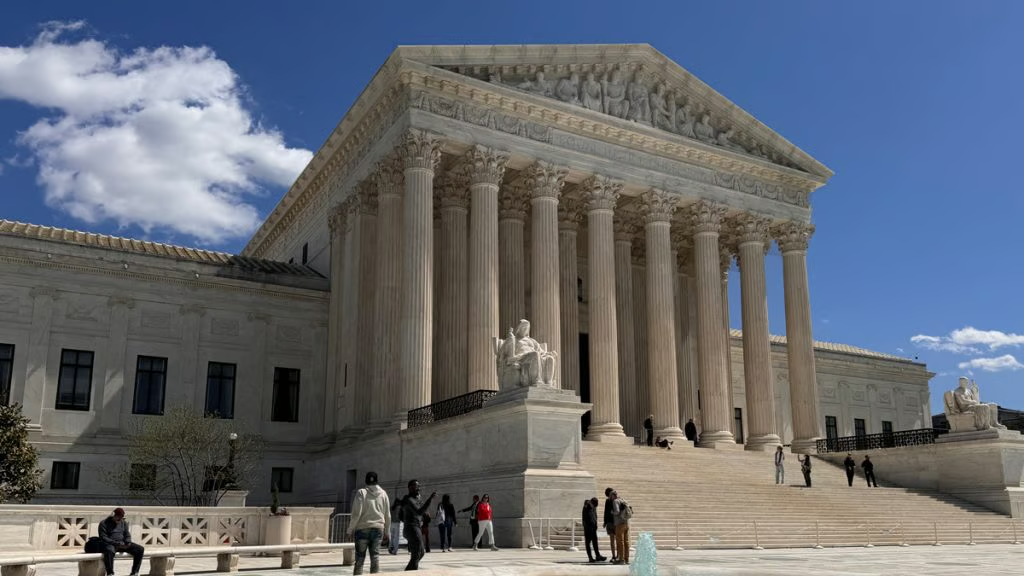
WASHINGTON — On Thursday, June 18, the Supreme Court issued a decision in a case addressing firearms possession, along with being an unlawful user of a controlled substance. The decision will likely have ramifications that impact the interpretations of both federal and state laws and how prohibitions on the use of controlled substances, like marijuana, apply to gun owners.
The court ruled unanimously in United States v. Hemani and affirmed the judgment of the Fifth Circuit, which had upheld the district court’s dismissal of the indictment against Ali Hemani, who was charged under 18 U.S.C. Section 922(g)(3) for knowingly possessing a firearm while being an “unlawful user” of a controlled substance (marijuana).

The U.S. Supreme Court granted cert in the case in October of 2025, and heard oral arguments on March 2 of this year, just shortly before the Justice Department rescheduled marijuana in April, a move that it had both telegraphed early on in the administration, and one which left gun owners with many questions. The Supreme Court’s decision in Hemani will likewise raise the question of how the prohibition applies to gun owners if the Justice Department fails to give further clarification on Form 4473.
The short form of the narrative in this case is that Ali Hemani, a dual citizen of the United States and Pakistan, who the government was investigating for suspected ties to terrorist organizations, was the subject of a home search in 2022 in which agents discovered a firearm and marijuana. He was charged with knowingly possessing a gun in his home while being an unlawful user of a controlled substance, and raised a Second Amendment defense.
The court entertained the Second Amendment challenge, acknowledged the prohibition imposed by the Gun Control Act, and proceeded to apply the Bruen test in which “the government acknowledges, it has a burden to carry,” adding, “The burden the government sets for itself in this case is a considerable one.”
The court dismantled the government’s use of “habitual drunkard” laws as the analogous law being used to defend the complete prohibition of firearms from a use of a controlled substance, writing, “And the habitual drunkard laws on which the government relies here differ dramatically from Section 922(g)(3)’s unlawful user provision on every single metric the government invites us to consider…”
The court’s decision in this case also reflects the reality of a changing culture in which marijuana use is increasingly considered benign. In his concurring opinion, Justice Alito noted, “In these circumstances, marijuana use today is like alcohol use at the founding. It is widespread and increasingly considered socially acceptable in many quarters. And from a practical standpoint, law enforcement widely tolerates the use of marijuana.”
The court also dismissed the government’s use of vagrancy and surety laws as analogues to disarm “unusually dangerous” individuals. It further addressed the government’s lack of clarity in imposing a complete ban while not accounting for circumstances:
…the law automatically bans an individual from possessing a gun from the moment he becomes an unlawful user of any controlled substance until he ceases being one. The law, says the government, doesn’t require anything more. It doesn’t matter what controlled substance an individual uses, in what amounts he does so, or whether his drug use has ever made him a danger to himself or others. It doesn’t even matter why he keeps a gun or how safely he does so.
In one of its strongest criticisms of the challenged measure, the court expresses doubt that the law claims to achieve what it set out to do, stating, “There are reasons to doubt that the government has established that Section 922(g)(3) even serves the purpose the government claims, of disarming categorically violent and unusually dangerous persons.”
And finally, the court notes the two-faced position of the Department of Justice on this very subject:
Additionally, the government’s own regulatory actions undercut its position: the Department of Justice has directed federal prosecutors to curtail enforcement efforts against marijuana users, most States have legalized marijuana use to some degree, and the government recently moved some marijuana products from Schedule I to Schedule III.
Interestingly, although the judgment was unanimous, with Justice Gorsuch writing the opinion of the court for a seven-justice majority, Justice Jackson, joined by Justice Sotomayor, filed a concurring opinion, while Justices Alito and Kagan concurred only in the judgment. Justice Jackson characterized the court’s major 2A precedent as the “failed Bruen experiment” and called for a return to “an explicit assessment of Congress’s ends and means when deciding the constitutionality of firearm restrictions.”
Though the court’s holding in this case is narrow, it adds this warning:
Affording the government ‘broad power to designate any group as dangerous and thereby disqualify its members from having a gun’ would risk allowing it to ‘quickly swallow’ the Second Amendment.
The opinion invites further scrutiny from both states and the federal government on how they apply laws intended to limit the behavior of gun owners as it relates to substances that are now in common use – a thought that might be of particular interest to this court.
This is only the second case related to the Second Amendment that the court has heard in this term. On January 20, it heard oral arguments in Wolford v. Lopez, but the case is still pending, and the court has not yet issued its opinion. Neither case addresses hardware issues, such as the much-anticipated case on AR-15 bans.