


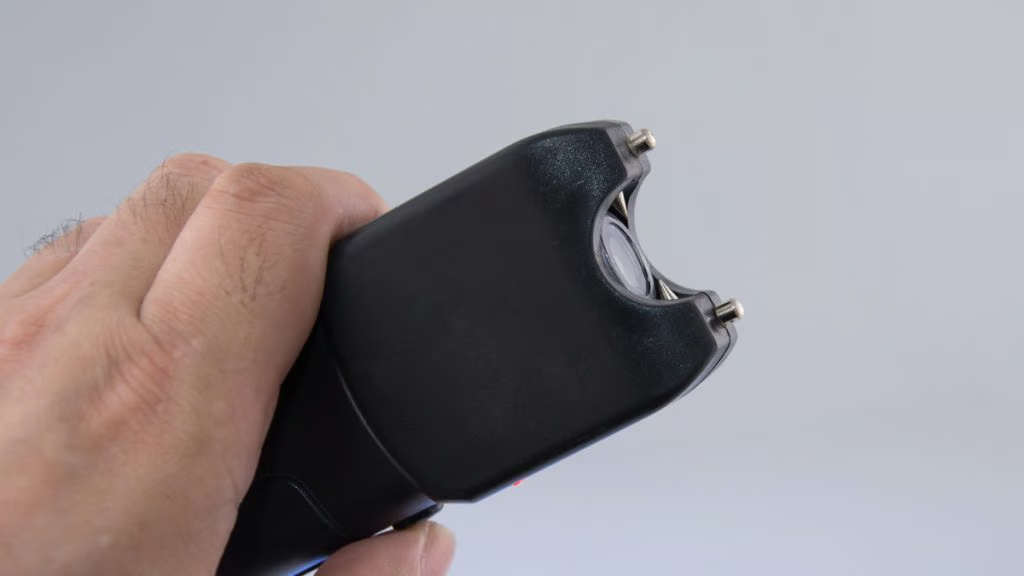
On Monday, April 13, 2026, the U.S. Court of Appeals for the Second Circuit issued a summary order upholding a lower court’s ruling that New York City’s ban on stun guns and tasers is constitutional. The decision comes after more than five years of litigation challenging the city’s and state’s prohibition on these commonly-owned, non-lethal self-defense tools, which are legal in most parts of the country.

In a statement posted on X, the Second Amendment Foundation (SAF) strongly criticized the ruling, stating, “This short summary order is a reminder of the extent to which the Second Circuit and other hostile courts will go to both abuse the Second Amendment, and ignore the historical analysis the Supreme Court established in Heller and reaffirmed in Bruen. It underscores why the high court must take a hardware case soon.”
The seven-page, non-precedential order was issued by a unanimous three-judge panel (Judges Barrington D. Parker, Raymond J. Lohier, Jr., and Sarah A. L. Merriam). It came almost exactly one year after plaintiffs filed their notice of appeal in April 2025 against the District Court’s summary judgment in favor of the City.
The case was brought by private individuals and supported by both the Second Amendment Foundation and Firearms Policy Coalition. They challenged N.Y. Penal Law Section 265.01 and N.Y.C. Admin. Code Section 10-135, which largely ban civilian possession of electronic weapons such as stun guns and tasers. As with all weapons bans, there are exemptions for law enforcement.
The Second Circuit agreed with the lower district court, holding that plaintiffs “failed to provide any evidence that stun guns and tasers are in common use” and that, on the summary judgment record, “no reasonable jury could return a verdict that stun guns and tasers are presumptively protected by the Second Amendment.”
The appeals court improperly applied the two-step Bruen framework but concluded the case failed at step one. It added its own caveat not found in the plain text of the Second Amendment: weapons that are “in common use today for self-defense.”
The court placed the burden of proof on plaintiffs at this stage, whereas Bruen places the burden on the government at step two to demonstrate a historical tradition of regulation. Because the court found the case failed its Step One test, it never reached the historical-analogue analysis.
Though related, the court does not cite one of the most well-known cases addressing stun guns. In 2016, the U.S. Supreme Court heard Caetano v. Massachusetts, addressing a conviction for use of a stun gun. The Court unanimously vacated the state court’s ruling, holding that the Second Amendment protects all bearable arms—even modern ones not in existence at the founding—and that the ban could not be upheld because it was not consistent with the precedent set in Heller. The case was remanded without a final ruling on stun gun rights.
For a deeper legal analysis of the decision, see the SAF thread here.













Join the conversation
Sign in with one click to comment under your name, or comment as a guest below.