

WASHINGTON — It has been three weeks since a federal judge enjoined enforcement of certain National Firearms Act (NFA) registration and approval requirements for now-untaxed items. The August 5, 2026, ruling in Silencer Shop Foundation v. ATF has created new options for some gun owners while leaving the broader firearms community with more questions than answers.
Although the Department of Justice did not seek to extend the seven-day stay that temporarily limited enforcement against the covered parties, the ATF has still issued no official guidance on how the ruling should be applied. The lack of direction has produced differing interpretations and a patchwork approach to sales, transfers, and compliance.

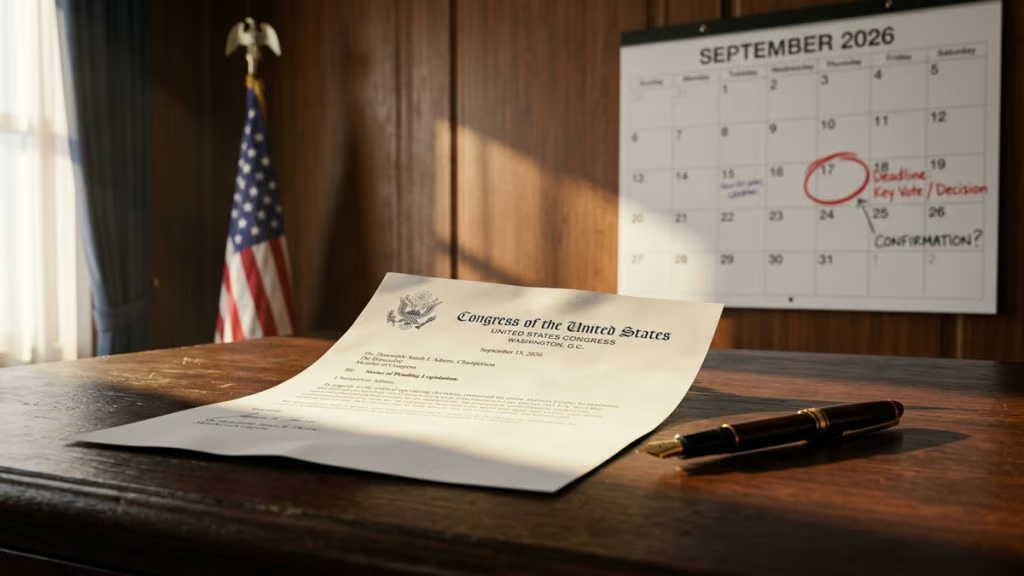
On Thursday, August 27, Kansas Rep. Tracey Mann sent a letter to ATF Director Robert Cekada raising the same concerns circulating among firearms businesses and owners:
The ruling has created uncertainty for law-abiding firearm owners, manufacturers, and federally licensed firearms dealers. The ATF has a responsibility to provide clear and timely guidance explaining how the ruling will be implemented and what requirements remain in effect, and I urge the ATF to act swiftly in accordance.
The uncertainty affects not only individuals who want to acquire these items but also businesses that sell and transfer them, including many small shops. Dealers that guess wrong about the law risk consequences that can include license revocation. Mann addressed that point directly:
The uncertainty surrounding the ruling directly affects the individuals involved in NFA regulated transactions, and without clear guidance from the ATF, they will be left to determine for themselves how the ruling affects their livelihoods.
The rule also impacts how law enforcement will handle the non-taxed NFA firearms at the state level, where legal. Case in point, in an August 27 letter to his colleagues, Montana Attorney General Austin Nnudsen laid out the situation for fellow law enforcement officers, writing:
The Montana Department of Justice does not want to see otherwise lawabiding Montana citizens criminally prosecuted at the state or municipal level for possessing, manufacturing, and/or transferring items that are now, at least for the time being, federally legal under Judge Hendrix’s Order,” adding, “As discussed above, there is still much uncertainty surrounding this matter.
As previously reported, the Department of Justice still has until early October to appeal the final judgment. Some have treated the decision not to extend the stay as a signal of the administration’s position. However, that remains an interpretation, not a settled legal outcome. Gun owners and businesses still need answers.
Mann wrote, “If the court’s ruling prevents the ATF from enforcing certain NFA registration requirements, the ATF should promptly communicate what requirements remain in effect and what procedures are no longer required.”
The Kansas representative asked for clarification on six points:
- What steps the ATF has taken so far to implement the ruling;
- How the ruling will affect Form 4 application and approval processes;
- What federal NFA registration requirements will remain in effect following the ruling;
- How the ATF intends to handle existing and pending applications;
- What procedures firearm owners, manufacturers, and dealers should follow going forward; and
- A date on which the ATF intends to publish official, finalized guidance.
He requested a response no later than September 17, 2026.
Although Congress has sought to influence the DOJ previously, such as encouraging the department not to appeal the ruling, it’s unknown what impact they ultimately have.
What is certain is that the more time goes by before guidance is provided, the more widely the standing decision will be interpreted. Some in the 2A community have gone even further, advocating that Americans must take back their rights by ignoring unconstitutional edicts and favoring mass non-compliance – a position that is hard to argue with given how far we’ve come from the writing of the Second Amendment.
“It appears we are on the verge of the biggest win the gun community has ever had, certainly the one with the most immediate and widespread impact on restoring rights we lost in 1934 and until recently had no real belief they’d ever be restored,” said Justin Nazaroff, CEO of Fenix Ammunition, adding, “While I understand the hesitancy of some to test the validity of the decision, we have the opportunity to create an administrative and paperwork nightmare for our government adversaries and it’s incumbent upon us to do so.”