
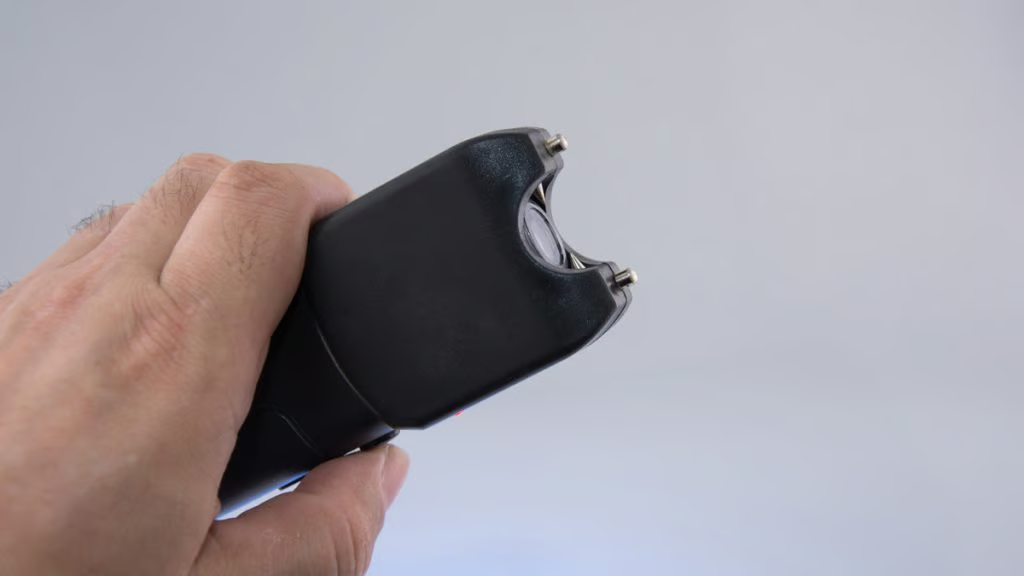
Anti-gun states can no longer make the argument that the laws they are proposing are for “public safety” when they are purely punitive. A recently proposed bill out of Hawaii requires concealed carry permit holders to also carry an electric stun gun, and would revoke a carry holder’s permit if they don’t.
SB 3039, introduced on January 23, “Prohibits persons with a license to carry a firearm from carrying a firearm on the licensee’s person without also carrying an electric gun on the licensee’s person. Requires a person’s license to carry a firearm be revoked if the licensee carries a firearm without also carrying an electric gun.”
The proposed bill is built on many assumptions, most of which are false:
The legislature finds that carrying a lethal firearm as the only means of defense often increases danger to the public. Data demonstrates that lethal firearms intended to be wielded by a victim to defend themselves often end up being used against the victim or being used to kill another person, instead of being used successfully for self-defense. Other times, individuals using firearms in self-defense injure or kill innocent bystanders.

What data? It’s not disclosed.
In fact, public sources prove otherwise.
According to one of the most conservative reports available – the latest National Crime Victimization Survey (NCVS) data from the Bureau of Justice Statistics – there are an estimated 69,000 defensive gun uses per year, 2019-2023 (other reports place DGUs in the hundreds of thousands to millions).
Although the NCVS does not track how many of these result in the offender being killed, the FBI does track “justifiable homicides,” which it defines as “the lawful killing of a perpetrator of a serious criminal offense by a law enforcement officer in the line of duty [or] by a private individual.”
Over the 2015-2024 period, only about 0.40% of the estimated 690,000 defensive gun uses resulted in a justifiable homicide by private citizens, meaning over 99.5% did not end in the offender’s death.
But beyond the incorrect conclusions from the legislature, the bill is unconstitutional on its face. It compels the purchase of a product. It penalizes somebody for not purchasing that product. In that penalty, it permanently removes their constitutional rights to self-defense, even though they have committed no other crime.
Although it’s questionable whether the measure would pass, it underscores the need for the public to get involved and voice their concerns when unconstitutional measures are proposed.
The bill was referred to the committee on January 30 and was sponsored by Stanley Chang (D), Chris Lee (D), and Glenn Wakai (D).