
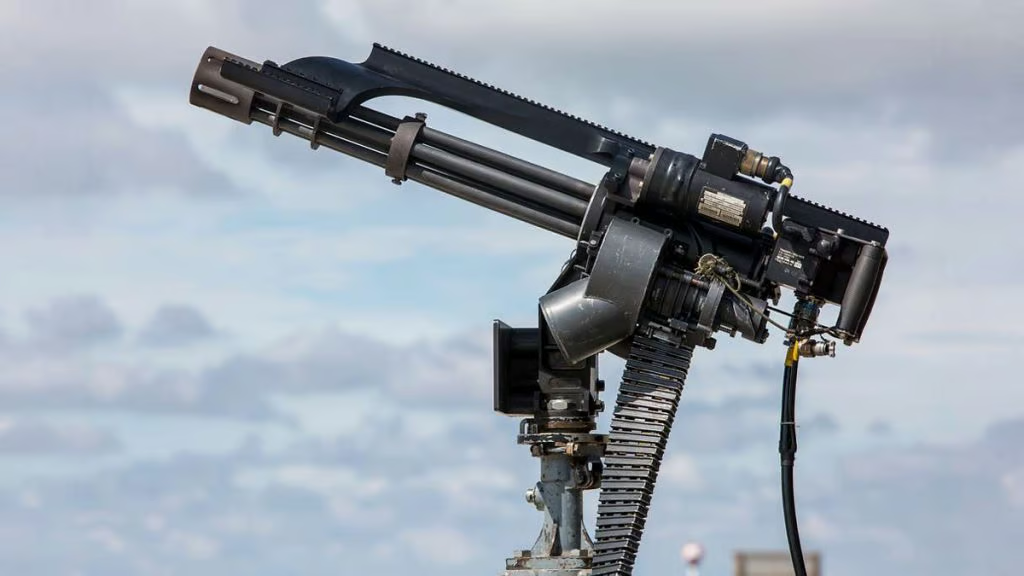
On March 3, the Eighth Circuit Court of Appeals issued a decision in a machine gun possession case backed by numerous gun rights groups. The opinion broadly reinforces two classes of rights and hints at what is likely to be a brand-new fight in the 2A battlefield.
United States of America v. Brad Wendt includes charges about making false statements and defrauding the ATF (which is rather humorous), but fundamentally revolves around 18 U.S.C. Section 922(o), a subsection of the federal Gun Control Act which in particular regulates machine gun possession after 1986. The case is on appeal from the United States District Court for the Southern District of Iowa – Central Division.

The case is backed by a long list of gun rights groups, firearms manufacturers, and 2A-friendly states, including:
- Firearms Regulatory Accountability Coalition, Inc.
- Palmetto State Armory, LLC
- B&T USA, LLC
- Gun Owners of America, Inc.
- Gun Owners Foundation
- State of West Virginia
- State of Arkansas
- State of Missouri
- State of New Hampshire
- State of Utah
- State of Kansas
- State of Montana
- State of South Carolina
The narrative is fairly straightforward, but almost unbelievable in the scope of the defendant’s temerity.
A small town gun shop owner, Brad Wendt, became the police chief of Adair, Iowa (population ~800) in 2018. Using his new office and legal powers, he wrote “law letters” authorizing the purchase of demonstration machine guns, ostensibly for testing, evaluation, and potential purchase by the police department.
In reality, he used these letters to help himself and other FFLs buy and resell machine guns. And on one occasion, while off duty and out of uniform, he brought a department-registered M60 to a remotely-located civilian machine gun shoot that his business sponsored and operated.
Wendt’s “law letters” were written from himself as police chief to himself as owner of BW Outfitters. This peculiarity, along with his increasing appetite for larger and more powerful machine guns are likely what caught the attention of the ATF. He wrote a letter requesting an M2, .50-caliber, belt-fed machine gun (readers will remember he came from a town of 800) “for possible future purchase and use of our officers in the performance of their official duties.”
Wendt then upped the ante, writing a similarly-worded letter to acquire a demonstration of a GAU-2b minigun, adding that it was “particularly suitable for use as a law enforcement weapon,” according to the government’s brief. In August 2022, the FBI executed search warrants at Wendt’s gun store in Denison, Iowa, and the Adair Police Department, the first steps in an investigation that led to his indictment in December 2022.
Following a jury trial, Wendt was found guilty on 11 counts, sentenced to a below-guidelines term of imprisonment of 60 months, a fine of $50,000, and forfeited 15 firearms. Wendt’s appeal includes technicalities surrounding jury instructions and specific phrasing regarding the characterization of “law letters.” He also alleges an “abuse of discretion” by the district court, and “ambiguity,” both related to jury instructions.
In spite of these technicalities, it is the overall finding of the Eighth Circuit that we find interesting in this case. In their 28-page decision, Circuit Judges Kelly, Erickson, and Stras issued a “1-1-1” ruling (sometimes called a fractured panel), where Judge Erickson wrote the lead opinion, Judge Stras wrote a separate opinion concurring in part and concurring in the judgment, and Judge Kelly wrote a separate opinion dissenting in part. Only two of three judges agreed in reversing the machine gun possession charge (the case was remanded back to the district court).
Addressing the vagueness aspect of the 18 U.S.C. Section 922(o) exemption, Judge Stras writes in the lead opinion, “A person of ordinary intelligence would not have fair notice that possession of a machine gun by the police chief at the machine gun shoot was illegal under federal law.”
He then doubles down in support of Wendt’s actions under 18 U.S.C. Section 922(o):
Handling and managing the weapons of the Adair Police Department was part of Brad Wendt’s job as police chief. The question is whether the federal machinegun ban, see 18 U.S.C. Section 922(o), limited what he could do with them. In my view, it does not police the police.
He goes on to assert that, “Broad exceptions for law enforcement are also consistent with the nation’s historical tradition of firearm regulation,” adding, “The Bruen framework explains why. The machine gun Wendt possessed was a ‘bearable Arm’ under the Second Amendment.”
Judge Stras’s logic is difficult to follow. He presumes machine guns are protected, bearable arms under the Constitution, but also that exemptions should apply to law enforcement. All of his examples are from the 19th century, well beyond the founding era.
Judge Kelly disagreed with the dismissal of the machine gun charge, writing “…he was not acting as a police officer when he possessed the machine gun that formed the basis of his Section 922(o) conviction. He was not in Adair, nor was he engaged in police-related activity or training. He was miles away, working on behalf of his own private business…”
Although the constitutionality of 18 U.S.C. Section 922(o) was not being challenged in this case, it does raise the question: if one class of private citizen may possess certain arms, why may not all citizens have the same right?
It is a question that will likely receive even more legal scrutiny as there are now three states that have created legislation to transfer machine guns to civilians under the exemptions provided in the law, with West Virginia leading the way on this novel approach.
As pointed out by the Director of Legal Research and Education at the Second Amendment Foundation, Kostas Moros, the opinion in this case seems to acknowledge the West Virginia legislation, asserting, “The public authority exception is clearly unavailable to private citizens.”
Whether that is true or understood to be true by our court system will be a new legal battle that is yet to be had.















Why not just get your Class III license, and not play games, this is kinda retarded and besides, your full auto weapons are out of most peoples price range