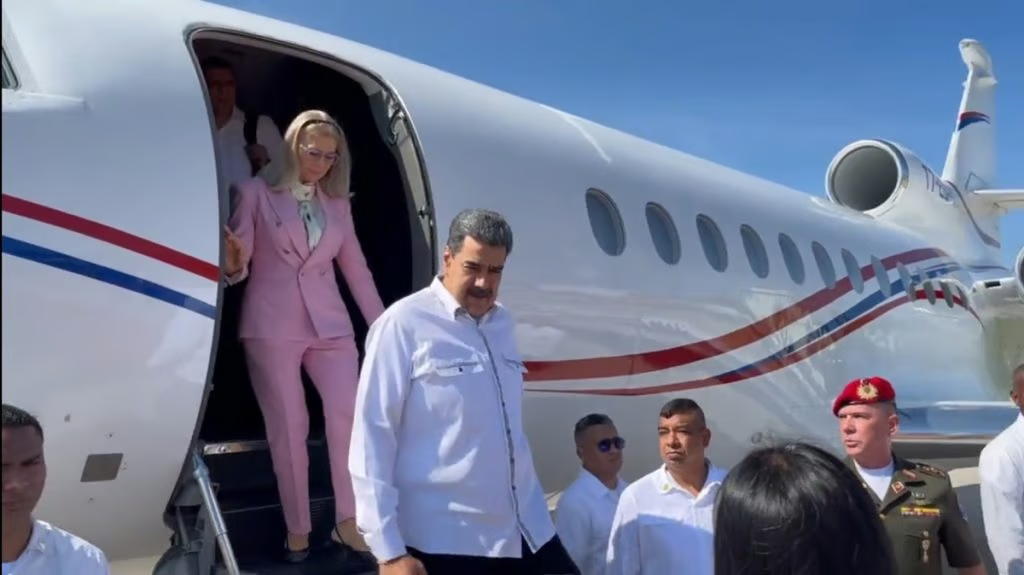
In the early morning hours of January 3, U.S. special operations groups conducted a mission that resulted in the capture of Venezuelan dictator Nicholas Maduro.
Maduro’s illegitimate reign and usurpation of power have been well documented. More than 55 countries condemned the 2020 elections and refused to recognize them as legitimate. In January of 2025, the Biden Administration issued a $25 million bounty for information leading to the capture of Maduro. Then again, the international community denounced the 2024 election that kept Maduro in power, showing the election violated the country’s own laws. In 2025, the U.N. issued a report documenting severe human rights abuses.

Shortly after the announcement of Maduro’s capture, the Pam Bondi Justice Department unveiled a sealed superseding indictment that caused a significant backlash from both the Second Amendment community as well as legal analysts.
The indictment focused on four main statutory allegations:
- Narco-Terrorism Conspiracy (using drug trafficking to support terrorism-like activities).
- Cocaine Importation Conspiracy (plotting to import huge amounts of cocaine into the U.S.).
- Possession of Machineguns and Destructive Devices (in connection with drug crimes).
- Conspiracy to Possess those weapons.
Most significant about the indictment is that 50% of the charges are machine gun possession related to narco-terrorism activities. Critics of the Bondi DOJ (which include this publication) were quick to point out that the indictment and charges brought against Maduro were using laws widely seen as infringements upon the Second Amendment. Many viewed this as yet another example of the Bondi DOJ supporting the NFA. That is only a partially true statement.
In November of 2024, the Bondi DOJ did indeed defend the NFA in a legal brief before the Supreme Court, finding itself on the same side as anti-gun groups also defending the NFA, and in opposition to Congress, which penned two different joint letters to the DOJ expressing serious concern about its legal position, much to the frustration of gun owners.
The indictment against Maduro, however, dates back to 2020. The 2020 indictment (version S2) was issued under then-President Donald Trump and announced by then U.S. Attorney General William P. Barr. The recently unsealed version S4, which was released on January 3, 2026, by the Bondi Justice Department, contains the same four charges but has been modified to reflect the different people and groups involved in the drug and gun-running operations in the intervening years.
Machine guns have been defined and regulated under the National Firearms Act (NFA) since 1934, with updates in the 1968 Gun Control Act (GCA). Both are currently being challenged in significant lawsuits, including a couple known as Silencer Shop v. Bondi and Jensen v. ATF. However, the charges against Maduro cite violations of 18 U.S.C. Section 924(c) (last updated in 2022). This updated statute makes it a separate crime to use, carry, or possess any firearm (including NFA items) “in furtherance of” major drug trafficking offenses adding a minimum of 30 years of mandatory prison time (consecutive to other sentences).
The firearms charges in the indictment read “…in an offense begun and committed out of the jurisdiction of any particular State or district of the United States,” would suggest that the violations did not occur in the U.S. The charges are, however, add-on, arguing the use of firearms was “in furtherance of” the drug-related activities that directly impacted the U.S. and its citizens. This is where there begins to be a gray area of how U.S. law may be applied extraterritorially when prosecuting offenses. There is case law addressing this, and the U.S. has a history of applying these laws when prosecuting international drug activity.
Regardless, the common thread here is not Pam Bondi, but the Trump administration itself, which is fundamentally using gun control laws designed to infringe upon U.S. citizens to bring the maximum penalty against Maduro and his cohorts, while at the same time trying to walk the balance between defending the Second Amendment, according to its February 2025 executive order.