


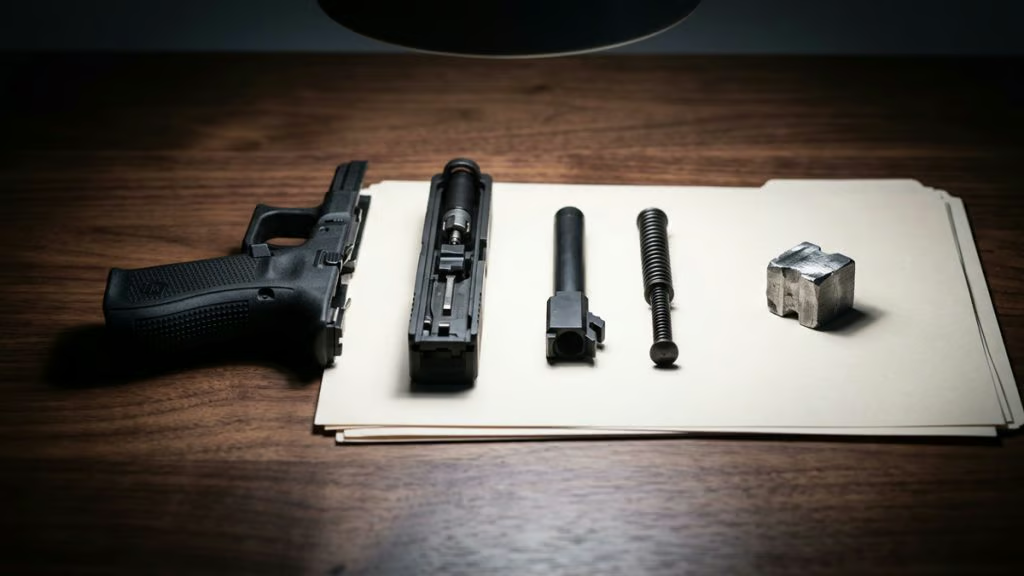
WILMINGTON, Del. — On Thursday, October 22, Glock, Inc. and Glock Ges.m.b.H., the Austrian parent company, became the targets of another lawsuit, this time from the state of Delaware, which alleges that they “knowingly designed, marketed, and sold handguns that can be easily converted into illegal machine guns using so-called ‘Glock switches.'”

State of Delaware v. Glock, Inc. was filed in the Court of Chancery of the State of Delaware by the Delaware Attorney General Kathleen Jennings, who made the outlandish claim that:
For decades, some gun manufacturers have hidden behind the myth that their industry has no moral consequences, that their stake in our communities ends at the cash register, and that they are neutrals in the war between law enforcement and gun violence.
The 82-page complaint presents four major allegations:
- A rise in crimes involving illegally modified Glock handguns
- Multiple seizures of illegally converted Glock handguns
- Claims that Glock ignored warnings from federal authorities and declined to redesign its firearms
- Claims that Glock’s marketing and social media content glorified fully automatic fire, despite such weapons being illegal for civilian purchase
The civil action was brought under 10 Del. C. Section 3930, a provision of the Keshall “KeKe” Anderson Safe Firearm Sales Act. Enacted in 2022 as Senate Bill 302, the measure allows for “Civil action for public nuisance by firearm industry member.”
The complaint has many hallmarks of a frivolous suit, seeking to impugn Glock, which makes legal firearms, for the actions of criminals. The complaint states, “While Glock itself does not produce these deadly items, many Glock switches still bear Glock’s logo.” The very act of fitting a switch to a firearm to allow it to perform automatic fire is itself a crime.
The suit is very similar to that which New Jersey brought against Glock in 2024. The similarity is not a coincidence. Delaware’s complaint lists former New Jersey Attorney General Matthew Platkin and Angela Cai as of counsel, both appearing pro hac vice, a special admission that lets an out-of-state lawyer appear in a single case.
Platkin personally brought New Jersey’s December 2024 case against Glock, captioned Platkin v. Glock until he left office, and he sued Sig Sauer over the design of its P320 pistol the following year. Cai argued New Jersey’s “Carry Killer” case, where she conceded the state had no evidence that concealed carry holders drive gun crime. Both are now at Platkin LLP, the Newark firm Platkin founded in February 2026, which lists “gun violence prevention” among its practice areas.
In September, the United States Court of Appeals for the Third Circuit allowed a lawsuit to go forward challenging New Jersey’s “public nuisance” law. Delaware sits in the Third Circuit alongside New Jersey, so if this suit reaches the appeals level, it would land before the same court that many legal experts expect to rule against New Jersey.
Glock has been largely silent as it has become the “whipping boy” of the anti-gun contingent, but the company recently filed an affirmative lawsuit against Connecticut over its convertible pistol ban in September, arguing the ban violates the First, Second, and Fourteenth Amendments, including being void for vagueness.
Attacks on lawful firearms manufacturers and distributors are a well-established tactic of the gun control cabal, and New Jersey recently doubled down on this tactic when it announced, in August, the hiring of a former Brady lawyer to “bring civil enforcement actions against firearm companies.”
















Join the conversation
Sign in with one click to comment under your name, or comment as a guest below.