
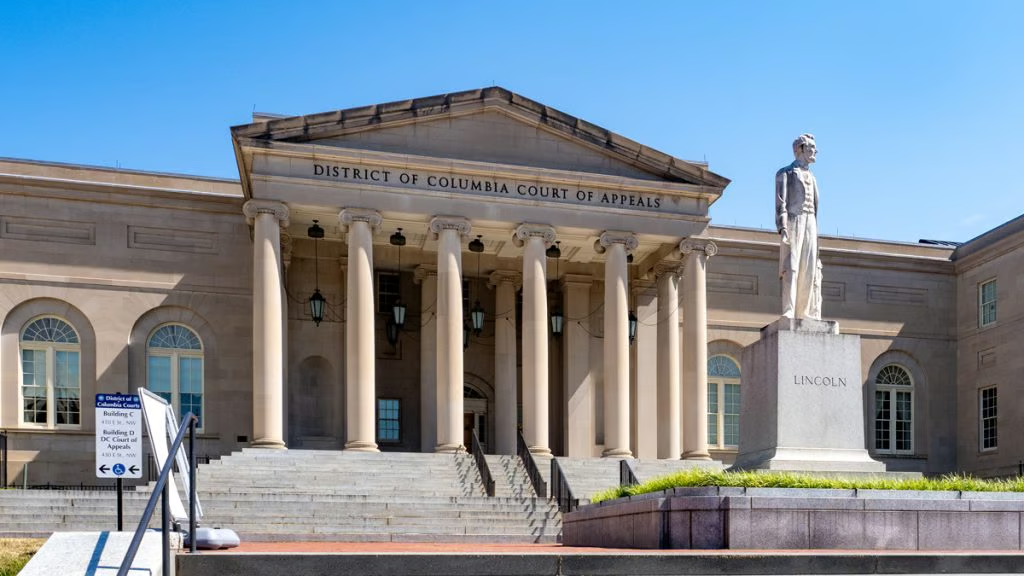
On March 5, the District of Columbia Court of Appeals issued a decision in a case the Department of Justice had previously defended, overturning a possession conviction for an individual who had a “large capacity magazine” in violation of the district’s ban.
The court ruled 2-1 to overturn the superior court’s conviction of Mr. Benson, who was charged with possession of a “large capacity ammunition feeding device,” possession of an unregistered firearm, carrying a pistol without a license, and unlawful possession of ammunition.

“This is a major Second Amendment ruling. You could say that it is the ‘second Shot Heard Around the World,'” said Alan Gottlieb, Chairman of the Citizens Committee for the Right to Keep and Bear Arms, adding, “Whether anti-gun lawmakers and liberal judges realize it or not, Judge Deahl’s opinion means the Second Amendment has teeth.”
In the court’s 84-page decision, the majority (Judges Easterly and Deahl) concluded that, “Because these magazines are arms in common and ubiquitous use by law-abiding citizens across this country, we agree with Benson and the United States that the District’s outright ban on them violates the Second Amendment.” The court also reversed the other three charges, as detailed below.
Chief Judge Blackburne-Rigsby dissented (rather vigorously), claiming inconsistency with Supreme Court precedent and leaning on other appeals courts that have upheld bans on what are commonly considered standard capacity magazines.
As noted in the decision, the DOJ “initially defended the ban’s constitutionality” during the trial at the superior court, but subsequently conceded the ban’s unconstitutionality when it filed a motion to vacate the conviction in September of 2025, signed by Assistant United States Attorney Chrisellen R. Kolb.
The court did not address Mr. Benson’s Second Amendment challenges regarding the district’s firearm registration and licensing schemes, nor his Fourth Amendment challenge regarding the search and seizure that led to his arrest.
The majority opinion described its analysis as taking a four-part approach:
- Lay the framework of the Heller, Bruen, and Rahimi Supreme Court decisions
- Apply the framework to the three central disputes:
- Whether 11+ magazines are arms protected by the Second Amendment
- The extent to which 11+ magazines are in “common use” for lawful purposes
- Whether there is any history and tradition of banning similar arms
- Reject the argument that Benson’s facial challenge should fail because of possession
- Assume that the unconstitutionality of the DC mag ban should invalidate the other convictions
Majority Analysis
“Heller made clear that any historical tradition of firearm bans in this country extends only to ‘dangerous and unusual’ weapons,” wrote the court going on to address why bans on magazines are simply fallacious: “The more sensible view is that magazines of all sizes, like other core components of firearms, are arms that are covered by the Second Amendment’s plain text as a threshold matter.”
The court then goes on to cite Hansen: “To hold otherwise would allow the government to sidestep the Second Amendment with a regulation prohibiting possession at the component level.”
The court then established that magazines are in common use for lawful purposes to the tune of “hundreds of millions of them in this country.”
In a beautifully logical sequence, the court then dismissed any basis for a historical ban, writing, “Our holdings resolving the first two disputes render this third one an afterthought: there is no historical tradition of banning bearable arms in common and ubiquitous use and Heller already held as much,” adding the obvious conclusion that “…because 11+ magazines are bearable arms in common and ubiquitous use, an outright ban on them violates the Second Amendment.”
In reversing Mr. Benson’s conviction for the magazine possession charge, the court noted that the possession precluded him from complying with D.C.’s laws regarding registering a firearm, obtaining a permit, and possessing ammunition, and subsequently reversed each of those charges as well:
And because Benson could not have registered, procured a license to carry, or lawfully possessed ammunition for his firearm given that it was equipped with a magazine capable of holding more than 10 rounds, we likewise reverse his convictions for possession of an unregistered firearm, carrying a pistol without a license, and unlawful possession of ammunition.”
Dissent
Chief Judge Blackburne-Rigsby’s dissent asserted that 30-round magazines are “particularly lethal” (providing no evidence as such), and disputed common use, writing,
The majority bases its common usage analysis on ownership statistics that show only that magazines holding 11, 15, or 17 rounds of ammunition are in common use. The majority, however, fails to contend with the reality that these statistics do not support the conclusion that the particularly lethal 30-round magazine… is in common use for self defense. It is not.
In one motion, the judge both penalized the many law-abiding for the actions of a few criminals AND employed an interest-balance approach when he wrote, “the majority undermines the District’s ability to ensure public safety and regulate 30-round LCMs, which have been used for dangerous and unlawful purposes, including mass shootings.”
In his legalistic approach, the judge makes the case for bans on magazines of any arbitrary capacity one may imagine, writing, “But even accepting that standard handgun magazines typically holding 11, 15, or 17 rounds of ammunition are in common use, there is no similar support for 30+ round magazines.” The reader may imagine a ban also on three-round magazines, nine-round magazines, and 33-round magazines under similar reasoning.
Judge Blackburne-Rigsby doubled down on what can only be interpreted as judicial activism reflecting a blatant hostility toward the Second Amendment, writing, “An extended ammunition clip [sic] capable of holding 30+ rounds is dangerous and is not commonly used for a lawful purpose such as self-defense.”
As the court reversed and vacated the four charges for Mr. Benson, the only remaining legal action available to the prosecution is an appeal to the Supreme Court, an action welcomed by gun-rights groups and Second Amendment advocates, given that the decision so thoroughly and properly applies previous precedent.














Millions of 30rd magazines in private hands, unserialized and probably untraceable, thus irregulable beyond regulation or control
The ban only affected the legal gun carrying law abiding citizens, the bad guys are the ones carrying the 30 round mags good call judges!!