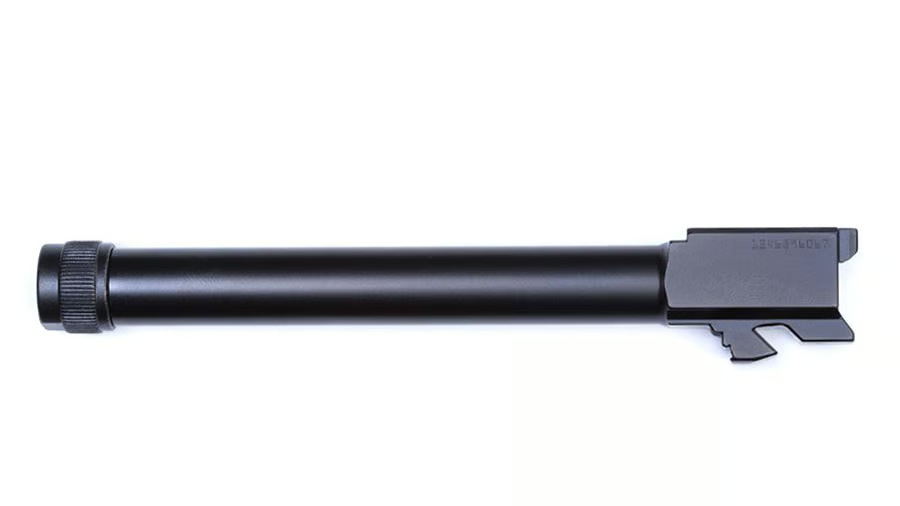
Anti-Second Amendment and anti-freedom bills are popping up like popcorn in a red-hot skillet, but they are becoming even more punitive and moving well beyond the authority of what is allowed to be regulated at the state or federal level. One such bill just proposed in Colorado would regulate what is functionally an inert piece of machined metal – firearms barrels.
Senate Bill 26-043, introduced in the Colorado General Assembly on January 27, would require all sales and transfers of firearm barrels to occur in person through a federally licensed firearm dealer (FFL), while establishing record-keeping requirements and criminal penalties for violations.

The bill was sponsored in the Senate by Sen. Sullivan and in the House by Reps. Froelich and Brown.
Under the bill, a “firearm barrel” is defined as:
(a) “Firearm barrel” means the tube through which a projectile or shot charge is fired. A firearm barrel includes any forging, casting, printing, extrusion, machined body, or similar article that has reached a stage in manufacture where it may readily be completed, assembled, or converted to be used as a firearm barrel, or that is marketed or sold to the public to become or be used as a firearm barrel once completed, assembled, or converted. A firearm barrel may have a rifled or smooth bore.
(b) “Firearm barrel” does not include a firearm barrel that is permanently attached or affixed to a firearm.
The attempt to regulate firearms parts is nothing more than a punitive measure designed to chill the expression of lawful Second Amendment rights. Evidence for that statement is found in the subjective language of the bill which prohibits “any person who is not an FFL from possessing a firearm barrel with intent to sell, transfer, or offer to sell or transfer it.” Intent is a largely subjective criterion which the state may weaponize against anyone whom it views as a political enemy.
The penalties for violating the statute are just as punitive, classified as a misdemeanor, punishable by a fine of up to $500 and up to 30 days in county jail; a second or subsequent offense would be a Class 2 misdemeanor.
Further, the bill mandates that FFLs record specific information (and retain these records for five years) for each barrel sale or transfer, including the date, purchaser’s identification details, name, address, date of birth, telephone number, and the make, model, and caliber of the firearm the barrel is designed for or used in.
This functionally creates an illegal database under the Colorado Bureau of Investigation that the state can use in a weapons confiscation scheme, such as the one Virginia alluded to in its recent slew of anti-gun measures.
As with every other anti-gun bill, this one includes several exemptions for law enforcement agencies, which are also composed of private citizens, creating a de facto, two-tiered system of rights which is blatantly unconstitutional.
If enacted, the provisions would take effect July 1, 2026.
One possible solution to such measures was passed in the Georgia legislature earlier this month. State Senator Colton Moore successfully championed a bill which allows individuals to sue offending municipalities.