On Friday, February 6, California Attorney General Rob Bonta filed a lawsuit against two organizations in an attempt to suppress free speech by seeking to halt the cross-state distribution and possession of computer code for 3D-printed firearms.
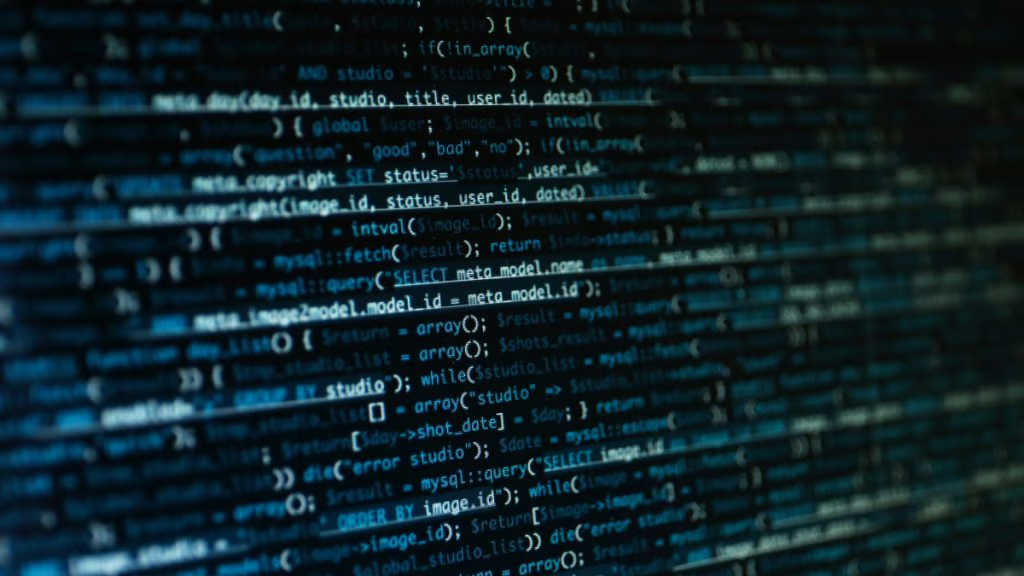
Although the case is presented as a “public safety” measure that directly impacts firearms and Second Amendment rights, it is likely to hinge mostly upon the implied free speech infringements underpinning the challenged computer code.
Bonta v. Gatalog Foundation, Inc. was filed in the Superior Court of the State of California, County of San Francisco. The 28-page complaint names two popular Florida-based companies that host websites that serve 3D printing files, The Gatalog and CTRLPew. It also names three individuals, including one who goes by the online moniker “Ivan the Troll.”

The complaint alleges that The Gatalog and CTRL Pew are breaking California law and contributing to a “public safety crisis from the proliferation of unserialized, untraceable, and unsafe firearms” that resulted in state law enforcement recovering “an average of over 11,000 ghost guns and auto-sears per year” from 2021 to 2025.
The complaint specifically alleges the companies are “…unlawfully distributing computer code for 3D printing firearms and prohibited firearm accessories and for promoting and facilitating the unlawful manufacture of 3D printed firearms and firearm accessories in violation of Civil Code sections 3273.61 and 3273.625 and the Unfair Competition Law…”
California law prohibits 3D printing of firearms and certain accessories without a license to manufacture firearms. Both § 3273.61 (which prohibits knowingly distributing digital firearm manufacturing code) and § 3273.625 (prohibits knowingly causing another to engage in unlawful firearm manufacture, or aiding/abetting 3D printing by unlicensed persons) took effect on January 1, 2026, via Assembly Bill 1263.
Not only do Americans have a long tradition of manufacturing their own firearms, but there is also legal precedent that acknowledges that computer code is protected speech under the First Amendment. Bernstein v. United States Department of Justice is one such well-known case, which the Electronic Frontier Foundation described as “a landmark case that resulted in establishing code as speech.”