

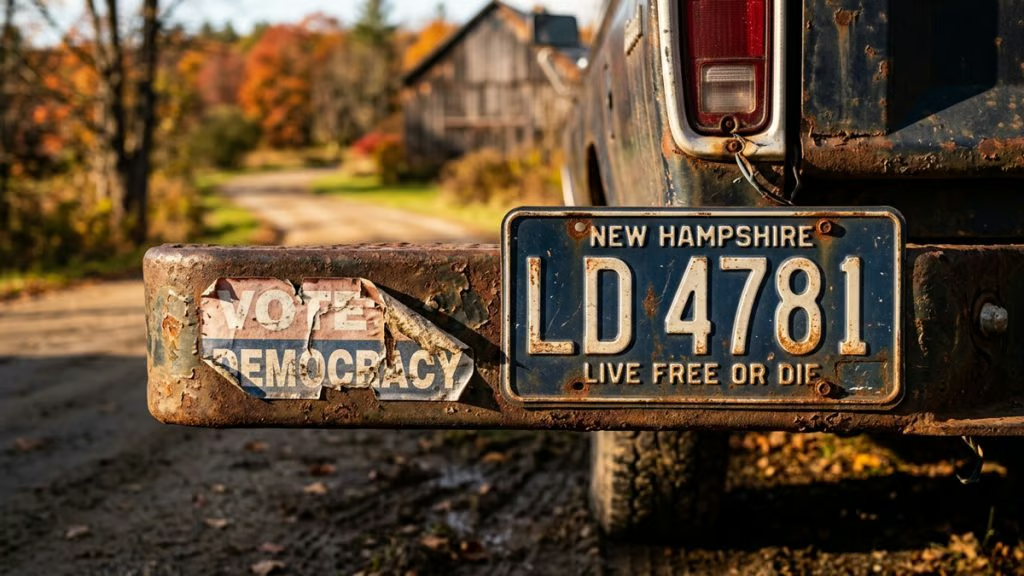
CONCORD, N.H. — New Hampshire is a perennial bellwether in national politics. It has been the first-in-the-nation presidential primary state for over 100 years, and a speech at Saint Anselm’s University has been a campaign trail first stop for presidential hopefuls ever since. New Hampshire is both notoriously politically purple and a fiercely pro-gun state. Based on Firearms Policy Coalition’s 2026 State Freedom Index, New Hampshire was tied for first place as the most pro-freedom, pro-gun rights state in the nation, which we recently covered here.

And yet, despite its significance and visibility in the national political arena, it can produce chaotic and disappointing results when it comes to selecting lawmakers to go to Washington.
On August 24, the National Rifle Association endorsed former Senator and Congressman John Sununu for the New Hampshire Senate GOP primary election to be held on September 8, in what will likely be a closely watched race in the 2026 midterms. His main opponent in the GOP primary, former Massachusetts Senator Scott Brown, received an “F” rating from the NRA.
The Sununu family is synonymous with New Hampshire politics. Both Sununu’s father and brother served as governor of the state, and he served prior terms in both the U.S. House and Senate. John Sununu was in office in 2004 when the vote to extend the 1994 so-called assault weapon ban failed, and was part of the pro-gun majority on Capitol Hill that allowed that law to sunset.
Scott Brown’s political legacy on the Second Amendment is very different, and typical of political operatives who use the 2A community’s backing to get to office, and then not only fail to deliver, but reverse course.
Brown took office in 2010 in a special election for the vacant U.S. Senate seat in Massachusetts, with heavy support from the NRA. In a recent press release, James Wallace, Executive Director of the Gun Owners Action League of Massachusetts and NRA board member, said, “After all those people worked through winter weather to get him elected, he couldn’t wait to get to Washington D.C. and start making deals for our rights.”
A little over a year after taking office, Brown publicly opposed concealed carry reciprocity, a longtime legislative priority for the NRA. “As you know, I support the individual right to keep and bear arms as guaranteed by the Second Amendment to the U.S. Constitution,” Brown told the Huffington Post in 2011. “I also believe that individual states should be allowed to decide what constitutes safe and responsible gun ownership so long as it does not violate that basic constitutional right.”
In the aftermath of the Sandy Hook shooting in Newtown, Connecticut, Brown capitulated again, telling Politico, “As a state legislator in Massachusetts, I supported an assault weapons ban thinking other states would follow suit. But unfortunately, they have not, and innocent people are being killed. As a result, I support a federal assault weapons ban, perhaps like the legislation we have in Massachusetts.”
This summer, the U.S. Supreme Court granted cert in two challenges to state-level assault weapon bans, one originating from Connecticut. Recently, President Donald Trump, standing alongside NRA president Bill Bachenberg, renewed his commitment to passing a federal law to guarantee national concealed carry reciprocity, a measure now supported by the full chorus of gun rights advocacy groups across the U.S.
Concealed carry reciprocity is of unique concern to Granite Staters. Residents in the southern part of the state frequently transit across the southern border into Massachusetts, and the Commonwealth has a long history of prosecuting out-of-staters traveling through the state, despite federal law that protects interstate travel with firearms.
While anti-gun-rights politicians have attempted to reintroduce a federal assault weapon ban in almost every session of Congress since 2004, those attempts have never advanced. In response to coverage of this issue in the New Hampshire Journal, Brown has attempted to calm his supporters by assuring them that he has never actually voted on it. “I never voted on it, and I’ve apologized so many times,” Brown was quoted as saying. He does have a long-standing history of bipartisan compromise. PolitiFact points out that in 2011, Brown voted with President Obama 70% of the time.
Brown’s prior positions leave him completely out of sync with his potential Republican colleagues on Capitol Hill. And in a state that leans heavily towards both conservative and libertarian values, the Senate primary in the Granite State could reveal a lot about where gun rights rank in voter priorities there.