


WASHINGTON — Getting approval from the ATF for a suppressor or short-barreled rifle or shotgun used to be an endeavor that took the better part of a year, or more. In many cases, the long wait times served as a deterrent to gun owners. That has changed for the good, and the story behind how and why it changed hasn’t really been told.
In the last two weeks, the ATF has announced dramatic reductions in processing times for NFA applications. According to ATF Director Cekada, the duration has been reduced from “14 months down to less than 24 to 48 hours, on average.”

On November 16, the ATF issued a press release announcing specific reductions in processing time for various forms, while handling “the highest-volume year in the agency’s history.”
According to the ATF, in the 2026 calendar year, the agency finalized about 2.5 million NFA applications. Average electronic processing times as of October 2026 included the following:
- Form 1 (Make and Register a Firearm): 5 days
- Form 4 (Individual) (Tax-Paid Transfer): 4 days
- Form 4 (Trust): 5 days
- Form 3 (Tax-Exempt Transfer to a Dealer): 1 day
- Form 5 (Tax-Exempt Transfer): 1 day
So how exactly did the ATF take a process that was lasting over a year and reduce it to a couple of days or less? And what were the real causes of the delays in the first place? Were they simply a product of outdated technology, antiquated processes and lack of resources? Or, were there inherent political motivations that were designed to provide systematic delays?
We decided to dig deeper and we asked all these questions, and more, directly of the ATF.
DOGE Conducts Independent Investigation
According to an ATF spokesperson at the Public Affairs Division, improvements to NFA processing began in 2023, with the NFA Division taking actions that reduced a backlog of more than 200,000 pending forms.
In July of 2025, then-Deputy Director Cekada requested a more in-depth review as part of a “broader effort to evaluate NFA operations, understand the causes of historical processing delays, and identify opportunities for further improvement,” according to the spokesperson.
The intent of the review was to “obtain an independent assessment of the systems, processes, and workflows that support NFA form processing.”
The key word here is “independent,” given that a self-conducted review would naturally strain credibility, especially from an agency that had – and in some cases still suffers from – a sullied reputation with firearms owners and federally licensed firearms dealers.
The entity invited to conduct the review was none other than DOGE, the Department of Government Efficiency, established by executive order in January 2025. Formerly known as U.S. Digital Service (and referred to hereafter as “DOGE/USDS”), the agency was headed by Elon Musk.
Although Musk was associated with DOGE at that time, he was not involved in the NFA review itself, according to the ATF spokesperson.
During the one-month “focused discovery sprint,” a primary team of at least three DOGE/USDS personnel conducted interviews, system and workflow reviews, and made observations in a “targeted operational review” that involved ATF personnel, contractors, technical staff, attorneys, and leadership.
DOGE Findings
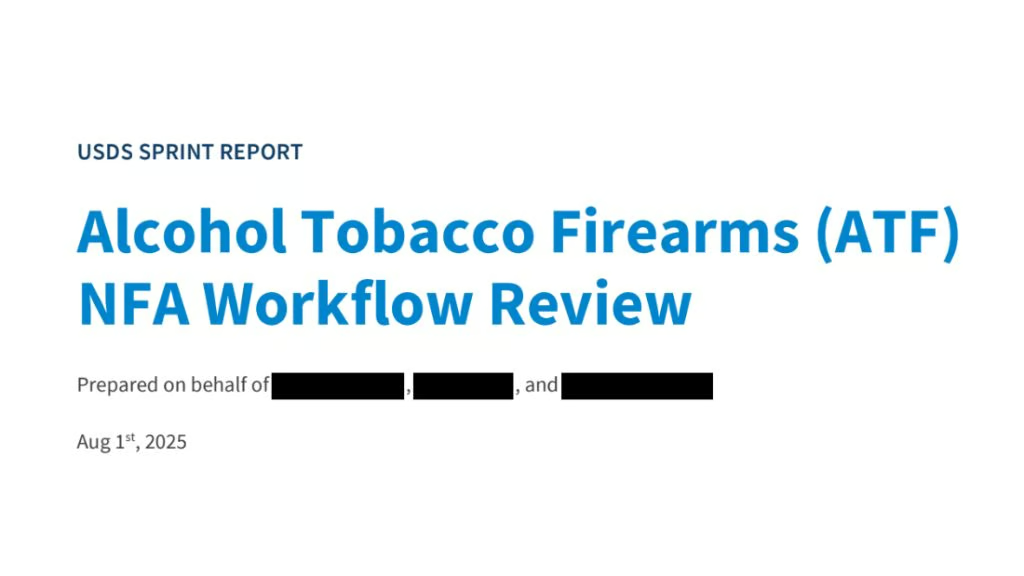
The DOGE/USDS findings were presented in a 16-page report (not publicly released), entitled “USDS SPRINT REPORT – Alcohol Tobacco Firearms (ATF) NFA Workflow Review.” The report was provided to ATF leadership.
Many American gun owners, including the News2A team, have been highly skeptical about the inner workings of the ATF, with evidence showing political ideologies oriented against Americans and their ability to exercise their constitutionally protected rights. And while that is true of some elements, the independent findings from the DOGE/USDS review paint a different picture for the NFA Division, one that isn’t unfamiliar to anyone who is familiar with legacy organizations or systems.
According to the ATF Public Affairs Division’s communication to News2A, “The findings were clear: The primary causes of long processing times were legacy technology, accumulated technical debt, complex system architecture, manual processes that could be automated, and very large application volumes.”
“After the report came out, the Director encouraged the continuation of process improvements where possible and has been focused on finding ways and funding to modernize legacy systems, which is where any future gains would likely come from,” the ATF spokesperson told News2A.
The report characterized the staff as “lean but effective” and suggested that NFA examiners “were highly optimized in their work.” In other words, the inefficiencies were not related to people, but to their tools.
“One of the more notable findings was that examiners often worked faster than the computer systems supporting them,” the ATF told us, adding that long processing times “were primarily the result of legacy technology, heavy manual workloads, large backlogs, and system limitations that had accumulated over many years.”
News2A asked directly if any processes were found to have built-in delays or evidence of political motivations affecting those processes, and the response from the ATF, based upon the DOGE/USDS report, was an emphatic “no.”
“There is no political agenda behind NFA processing times,” ATF Director Rob Cekada told News2A. “That’s why I requested DOGE perform an independent review of our NFA operations. What DOGE found is the truth: that our employees are committed to serving the public as efficiently as possible, that the improvements we’ve seen recently are the result of process change and hard work, and that any further improvements can really only be made by funding the modernization of legacy systems. Technology is our primary constraint.”
Instead, the review noted “significant technical debt, multiple interconnected systems, and processes that often required manual intervention where automation could have been used.” The findings mirror what citizens regularly see in other elements of the government processes: legacy systems, poor workflows, lack of automation, outdated software.
According to the ATF spokesperson, based on the DOGE/USDS review, the team at the ATF streamlined and improved the following processes, among others:
- Increased use of automated validation checks.
- Better use of Power BI tools to identify and prioritize actionable work.
- Grouping related applications to improve efficiency.
- Automated identification of common application issues that previously required manual review.
- Database and query-performance improvements aimed at reducing system wait times.
- Additional workflow automation to reduce manual data entry and repetitive tasks.
Did Speed Compromise Quality?
Critics of the ATF, including gun control advocates, will surmise that efficiency and speed somehow compromise safety, a challenge that the ATF acknowledged head-on when News2A asked how streamlined background checks were conducted without compromising legal requirements.
The ATF’s response was enlightening:
The aim was to find ways to make the process faster and more predictable while maintaining the same legal standards. Improvements focused on eliminating unnecessary administrative work and improving system efficiency, not eliminating statutory review requirements. Applications still had to satisfy all applicable legal requirements, including required background-check processes and other validation requirements. What changed was the degree to which technology could assist employees by automating routine tasks…
The spokesperson went on to add an important clarification on timing: slow isn’t always better.
“Quicker processing is actually BETTER for public safety. Processing forms as we get responses back from NICS reduces any lengthy gaps between when the background check has cleared and when the form is finally processed.” That outcome, closing the time gap between background checks and finalizing the application, would be hard for even gun control advocates to fairly criticize.
Finally, many of the ideas for improvements came from ATF employees themselves, according to the spokesperson, who stated that, “The report credits ATF personnel with making significant improvements…”
No follow-up audit is planned, according to the ATF, but “continuous process improvements” along with regular evaluations remain a focus.
None of the above should be construed to suggest that the ATF as a whole is free from an anti-gun bias, nor that it couldn’t benefit from further accountability. For example, as of this writing, the ATF still employs the firearms enforcement officer, Jeffrey R. Bodell, whose unethical testimony led to the imprisonment of Tate Adamiak, according to reporting by the Second Amendment Foundation. And according to recent reporting by Lee Williams, who works with the Second Amendment Foundation’s Investigative Journalism Project, the ATF maliciously destroyed firearms owned by pastor Russell Fincher, who was wrongly prosecuted by the ATF and pardoned by President Trump.
However, for the NFA Division at least, the proof is in the pudding, as the saying goes. The fact of the matter is that in 2026, the division processed 2.5 million applications and reduced the overall time from over one year to just a matter of days, benefiting all gun owners.










Join the conversation
Sign in with one click to comment under your name, or comment as a guest below.