


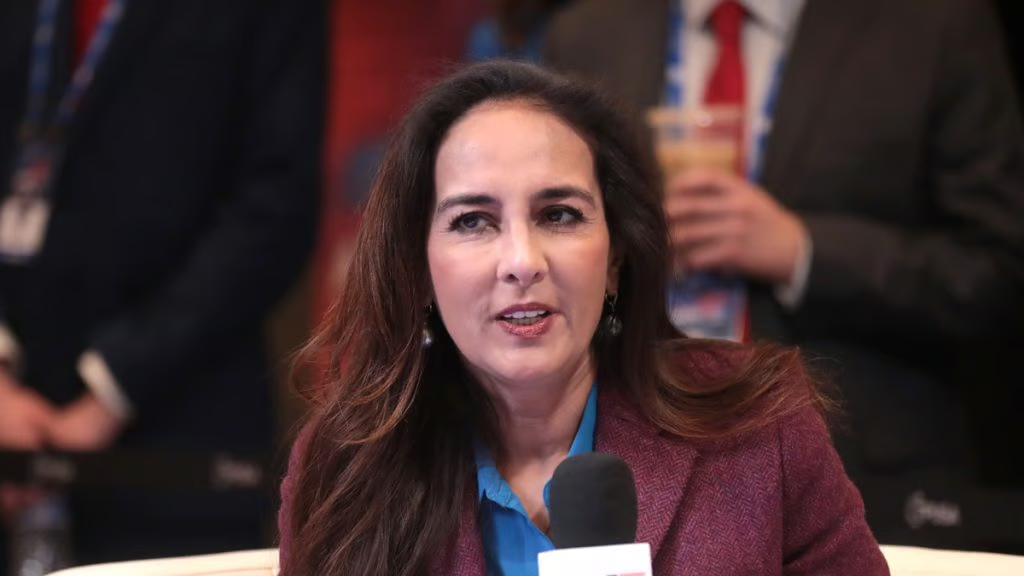
After President Trump signed an executive order to protect the Second Amendment in February of 2025, it took nearly a year to see any measurable actions out of the Justice Department that aligned with that order. However, 16 months later, the DOJ is now communicating a clear strategy on how it intends to fight infringements against Second Amendment rights.
Building a Pro-2A Division in the DOJ
In retrospect, the challenge for the administration was both structural and a communications issue. Gun owners expected to see immediate action subsequent to the historic executive order. Instead, they saw a Department of Justice that, under the leadership of Attorney General Pam Bondi, largely took legal actions supporting gun laws – so much so that we created an entire tracker dedicated to the Bondi DOJ’s actions.

In reality, the DOJ was building a new department dedicated to defending Second Amendment rights, and they smartly structured it under the Civil Rights Division, where they could bring enforcement under the umbrella of infringements on civil liberties. Building that team took time and resources. But the administration fell short of communicating that task, and simultaneously took a reputational beating in the public arena for the actions of the Bondi DOJ when it came to gun control.
It wasn’t until early December of 2025 that we formally learned about the newly-created Second Amendment Section from Assistant Attorney General for the Civil Rights Division, Harmeet Dhillon. Today, that section is fully ensconced and resourced within the DOJ, led by Acting Chief Barry Arrington, and reports directly to Ms. Dhillon, who takes an active role in its leadership and mission. According to the dedicated website, the Second Amendment Section is dedicated to ensuring “…that law-abiding American citizens may responsibly possess, carry, and use firearms.”
The section isn’t passive either, and has set the goal of searching out infringements that are enforced by law:
The 2nd Amendment Section will work diligently to investigate law enforcement agencies that engage in a pattern or practice of infringing on law-abiding citizens’ 2nd Amendment rights, as well as be proactive in searching for litigation opportunities to secure such rights.
The stated goal isn’t just to fulfill the mission, but to “advocate with zeal on behalf of the United States of America in furtherance of all objectives as tasked.”
To date, the Second Amendment Section has a 100% perfect record on 2A-related actions, which we have tracked extensively in our dedicated DOJ Action Tracker.
The Strategy
In a June 10 interview with The Daily Caller, Ms. Dhillon publicly laid out a strategy for how the Second Amendment Section will strengthen Second Amendment rights, and it involves litigation tactics that will force certain cases toward the Supreme Court. “We’re identifying places where we can help make new law or create a circuit split for purposes of ultimate Supreme Court determination,” Dhillon said in the interview.
There are 12 geographic circuits in the United States federal court system (each with one court of appeals), and when they disagree on an issue resulting in differing opinions, the cases are more likely to invite Supreme Court intervention for an ultimate decision. (The Supreme Court has historically heard only a handful of 2A-related cases during each term.)
The Second Amendment Section has been actively filing affirmative suits in jurisdictions that are likely to render decisions that split the courts of appeals. While the list of subjects is extensive (gun bans under 21; waiting periods, drug-related disarmament; storage requirements; ban on possession by felons; “vampire” laws; etc.), the section seems to have focused on particular subjects, including “assault weapons” and magazine bans, which it has characterized as “low-hanging fruit.”
A brief history of affirmative lawsuits by the Second Amendment Section includes:
- June 2026 – Lawsuit against Philadelphia over permitting scheme
- May 2026 – Amended lawsuit against Washington, D.C. over suppressor ban
- May 2026 – Lawsuit against Colorado over magazine ban
- May 2026 – Lawsuit against Denver over AR-15 ban
- January 2026 – Lawsuit against California over ammo background checks
- December 2025 – Lawsuit against Washington, D.C. over AR-15 ban
- December 2025 – Lawsuit against Virgin Islands over gun permit delays
The lawsuits above have been chosen carefully based on consideration of topic and jurisdiction and prior court rulings in those jurisdictions. According to Dhillon, “I think it’s safe to say that we have many, many targets throughout the United States. We’re familiar with all of these developments. We attend gun shows regularly and gun events. We have an open-door policy here vis-a-vis people who wanna bring things to our attention, but we have to prioritize based on our resources and our other enforcement priorities at the Department of Justice.”
The AR-15 ban is of particular concern to gun owners, which the DOJ seems to understand. In a June 4 post on X, Ms. Dhillon stated, “Several jurisdictions have banned magazines and guns to crush the 2A rights of millions of Americans. [The Justice Department] and this [Civil Rights] Division will keep fighting these jurisdictions to defend citizens’ constitutional rights.”
The Danger
While gun owners and Americans who believe in the Constitution are extremely grateful to see historic and unprecedented pro-2A actions from this administration and the DOJ, there are risks.
The most obvious risk is that the Second Amendment Section will likely be defunded and dismissed by a future administration, meaning they have a limited timeframe in which to do their work. At worst, the administration has less than two years to get the job done. At best, nobody knows.
Additionally, the strategy of seeking Supreme Court intervention itself has serious risks, one of which is timing. It often takes years – even decades – for gun control issues in particular to percolate and reach the Supreme Court. That’s a long timeframe in a political environment driven by four-year election cycles.
Finally, there is the risk of actions – or inaction – by the court itself. First, the court has to actually choose to hear 2A cases, and it doesn’t seem to be in a particular hurry to do so. Justice Kavanaugh gave one of the most substantial hints in 2025 when he stated that, “in my view, this court should and presumably will address the AR-15 issue soon, in the next term or two.”
A second risk relates to the court’s appetite for enforcement. The 2022 Bruen decision is widely seen as one of the most pro-Second Amendment decisions issued by the court in more than a decade. Yet, lower courts throughout the country consistently defy that precedent, issuing decisions that seem to fly in the face of the Supreme Court’s intent, or that cunningly twist the decision to render politically expedient outcomes preferred by activist judges – with seemingly no consequence.
Meanwhile, the greatest risk is that there is no penalty for lawmakers who continue to introduce infringing legislation – a tactic that anti-gunners continue to use at a local, state, and federal level, and one that the Civil Rights Division has yet to address strategically.