


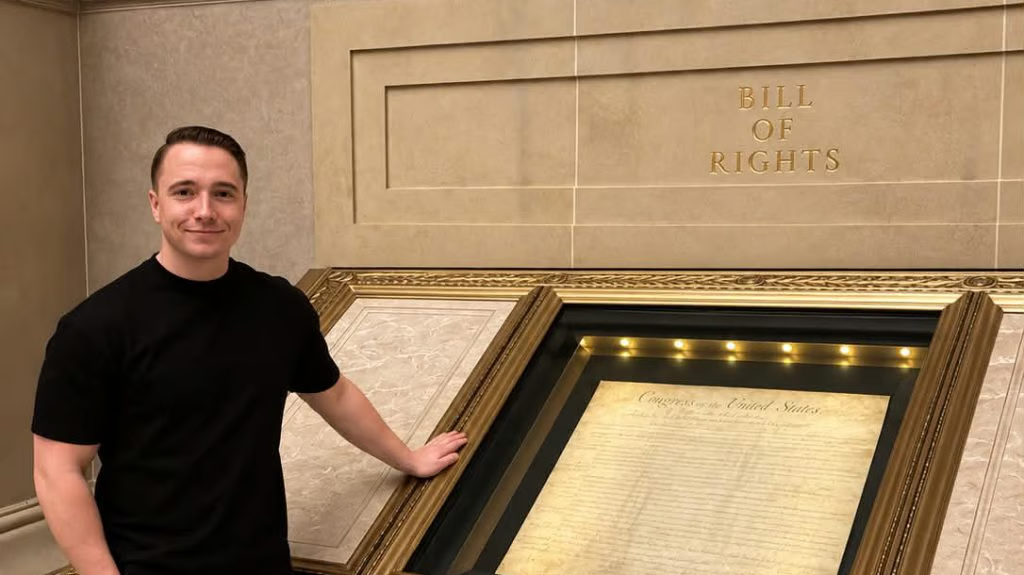
On September 3, 2026, President Trump pardoned Patrick “Tate” Adamiak after spending four years in federal prison.
If you’ve never heard his name before, Tate’s unique story is a contemporary example of the Machiavellian actions of a corrupt government agency that twisted the law to incarcerate an innocent man for political purposes.
Tate is a former Navy E-6 Master-at-Arms who enlisted at 17, earned a bachelor’s degree, and was accepted to BUD/S, which many know as SEAL training.
On the side, he bought and sold military gear and unregulated gun parts, including replicas, demilled parts, inert RPGs, and semi-auto firearms, all of which were legally purchased and possessed.
ATF agents, working with a confidential informant, raided his Virginia Beach home in 2022. Prosecutors alleged that he sold unregistered machine guns and possessed grenade launchers, antitank missile launchers, and other highly regulated items. ATF agents gave questionable testimony that led to a jury conviction in 2022 and a 20-year sentence in June 2023.
Tate’s story began to receive national attention, with a lot of credit due to the intensive reporting from Lee “The Gun Writer” Williams, who wrote more than 50 investigative reports about Tate’s case.
To see Lee’s reporting and to learn more about what happened to Tate, click here.
Below is one of the earliest interviews Tate Adamiak has granted since his release.

News2A: Mr. Adamiak, congratulations on your freedom, and thank you for taking the time to speak with us. It’s been four long years for you and your family. What did you anchor your hope to while in prison?
Tate: What kept me going was my belief that the truth would eventually come out and that, in time, people would understand what happened. I believed that if the right people learned the full story of my case, there would be an opportunity for justice.
Knowing that my family, friends, and supporters were out there fighting for me made an enormous difference. It allowed me to stay calm and focused because I knew I wasn’t forgotten. Even in the hardest moments, I held onto the belief that the facts mattered and that eventually they would be heard.
News2A: In covering your story, we’ve often posted that “any of us could be Tate.” Did you see yourself as a political prisoner of sorts?
Tate: I did view my case through that lens. From my perspective, I was targeted during a period of intense scrutiny and enforcement involving Second Amendment issues. I believe my case was less about public safety and more about sending a message about firearm ownership.
What happened to me was devastating because I was a person who was following the law, and I found myself facing consequences that changed every aspect of my life. I believe this case raised important questions about how laws are interpreted and enforced, and whether ordinary citizens have adequate protection when those interpretations change.
News2A: Were you aware of the massive support that you garnered within the 2A community?
Tate: Yes, I was aware of it, and I am beyond grateful. My family and friends immediately began advocating for me after my conviction. Early on, there were a few people covering my story, but as time went on, especially in 2025, the attention and support grew significantly.
My dad and brothers would give me updates almost every day about new coverage, messages of support, and people who were standing behind me. That meant more than I can explain. It helped me keep pushing forward and reminded me that people cared about what happened and were willing to fight alongside me.
I always believed that if the facts were brought to enough people, they would not be ignored forever.
News2A: It’s been reported that at least one ATF agent who figured prominently in the testimony that led to your conviction is still employed by the ATF. From your perspective, what would justice look like beyond the pardon from President Trump?
Tate: As far as I know, the individuals involved are still employed by the ATF. The person whose interpretations played a significant role in my case is, as I understand it, still involved in enforcement actions and testimony in other cases.
From my perspective, accountability is important. When government officials have significant authority over people’s lives, there needs to be a high standard of responsibility and transparency. I believe any questionable actions or interpretations should be independently reviewed to determine whether they complied with the law.
For me, justice is not only about my freedom. The consequences extended far beyond the years I spent incarcerated. I lost my career, relationships, financial security, and years of my life that I can never get back. The impact reaches far beyond a courtroom.
I would like to see accountability for what happened in my case and safeguards put in place so that another person does not experience what my family and I went through.
News2A: You’ve seen the workings of the federal government from a very different perspective than the average person. What have you observed about the strengths and weaknesses of our system?
Tate: My experience changed the way I view the justice system. I learned that the outcome of a case is not determined only by the facts or evidence; it is also heavily influenced by legal procedures, evidentiary rules, and the resources available to each side.
The government has tremendous resources, and defendants often face an incredibly difficult battle navigating a complex system. My experience left me believing that there needs to be stronger safeguards to ensure that the truth and the facts remain at the center of every case.
At the same time, I saw the importance of having people willing to step forward, whether that was attorneys, advocates, family, or ordinary citizens who cared enough to help. Those people reminded me that the system is also shaped by individuals who are willing to stand up and fight for what they believe is right.
News2A: You were convicted under the Biden-Harris administration. Since then, there’s been an election and a new administration guiding agencies like the ATF. What kind of reforms would you advocate for if you could speak to DOJ leadership?
Tate: There are a lot of issues within the DOJ that I experienced firsthand, particularly when it comes to how firearms laws are interpreted and enforced. I felt that lawful firearm ownership was portrayed in my case as something inherently suspicious or dangerous, rather than as the exercise of a constitutional right.
The first thing I would ask DOJ leadership to look at is the ATF’s Firearms Technology Division and the way technical determinations are made. My entire case hinged on interpretations by firearms enforcement personnel that went far beyond what the law actually says.
For example, testimony in my case included the idea that something as simple as a mark made with a Sharpie indicating where an auto-sear pin hole would be could potentially cause an item to be classified as a machine gun. That is an extraordinary interpretation to me.
I don’t think it is unreasonable to ask government agencies to simply follow the law as it is written. There needs to be clear, objective standards, transparency in technical determinations, and meaningful accountability when those standards are not followed.
News2A: As you’re probably aware, there’s a dramatically changing legal and even cultural landscape that is tilting in favor of gun owners at the moment, such as pro-2A Supreme Court decisions, affirmative lawsuits by the DOJ’s Second Amendment Section, portions of the NFA being enjoined, and high adoption of concealed carry, among others. How do you think these shifts will impact the relationship between the American people and their government?
Tate: I think the changes taking place around the Second Amendment are significant. I recognize the work being done by the current leadership at the DOJ and ATF, and I hope those changes continue to move things toward greater clarity and respect for constitutional rights.
But I also think there is a bigger lesson from cases like mine. Changes in the law are important, but there also need to be changes within the agencies responsible for enforcing those laws so that what happened to me cannot happen to someone else.
That means clear policies, objective standards, meaningful oversight, and accountability when government officials exceed their authority. The American people should be able to trust that the government is going to enforce the law as it is written, not according to someone’s personal interpretation of what they think the law should be.
Ultimately, I think restoring that trust is important for everyone, regardless of where they stand on firearms.
News2A: Our readers largely believe that our Second Amendment rights are the cornerstone for all others. You’ve likely had quite a bit of time to think on first principles. Can you share your thoughts on what your Second Amendment rights, and any other constitutional right, mean to you now in the context of what you’ve been through?
Tate: Absolutely. After everything I experienced, I have an even deeper appreciation for the Second Amendment and for constitutional rights in general.
I believe the Second Amendment is ultimately about preserving the ability of citizens to protect themselves and to retain a measure of power independent of the government. Without meaningful protection for our constitutional rights, I worry that the others can gradually become easier to infringe upon.
What happened to me also affected more than just my Second Amendment rights. My First Amendment rights were implicated as well. When I spoke publicly about my case and people began advocating for me, there were efforts to punish me for speaking out.
That experience changed the way I think about freedom. Constitutional rights can seem abstract when you are simply reading them on a page. When you have them taken away, you understand very quickly that they are not abstract at all. They are the things that stand between an individual and the enormous power of the government.
News2A: What kind of general advice can you offer to gun owners when it comes to possession charges and retaining legal counsel?
Tate: My biggest piece of advice is to take it seriously from the very beginning and find an attorney who actually understands firearms law and respects the constitutional rights involved.
You don’t just want someone who understands criminal law generally. You want someone who understands the technical aspects of firearms, the relevant statutes and regulations, and the Second Amendment issues that may be involved.
I was fortunate to eventually have attorneys who stepped up when many others would not, simply because they believed what was happening was wrong and believed it was worth fighting. Matthew Larosiere, Calum Welch, and Matt Finley were willing to take on an incredibly difficult fight, and I will always be grateful to them.
If someone finds themselves in a situation like mine, I would encourage them to get a good lawyer immediately and to make sure their attorney truly understands the firearms issues involved.
News2A: Did you have any sort of legal defense fund or insurance, such as US LawShield, Right to Bear, USCCA, etc.?
Tate: I did not have legal insurance when this happened. I ended up draining my life savings trying to get through the trial, and despite everything we put into the defense, I wasn’t even able to present the case the way we wanted because of the rules of evidence and procedure.
My supporters eventually established a legal defense fund to give us additional resources to continue fighting. That was a tremendous help, and I am incredibly grateful to everyone who contributed.
I honestly don’t know how we would have made it through without that support. Every contribution represented someone saying, in one way or another, “We haven’t forgotten you, and we’re willing to help you keep fighting.”
News2A: Have you received any of your property back?
Tate: So far, I have only received my electronics back, including my phone and computer, along with a check for the antique currency collection that was seized by the ATF.
That currency was originally characterized as proceeds of illegal activity, but it was actually a family heirloom that had been passed down to me. What makes that especially painful is that thousands of dollars worth of collectible and sentimental antique currency was deposited into a bank at face value, and I was ultimately given a check for that face value.
Something that had both significant collectible value and enormous sentimental value to my family is now gone forever, and I received only a fraction of what it was actually worth.
The ATF still has a substantial amount of my property, including property that they acknowledge is not illegal. I would like to see that property returned.
News2A: Have you attempted to make any purchases yet that require a NICS check?
Tate: No, I haven’t attempted a purchase requiring a NICS check yet. I want to make absolutely sure everything is in order before I do that.
For the last several years, I lived with the possibility that I might never be able to legally purchase a firearm again. That was devastating because firearms have been such a significant part of my life.
When I do make that first purchase, I want it to be something meaningful, something I’ve always dreamed about. After everything I’ve been through, I think that first transfer deserves to be a pretty special moment.
News2A: Are you still interested in pursuing a career in the United States military?
Tate: Yes. I’m already in communication with recruiters and exploring my options.
I still have a strong desire to serve my country in some capacity. That desire never really went away. If anything, everything I’ve experienced has given me an even deeper motivation to serve.
News2A: Assuming you still have an interest in firearms, what’s the first gun you’re considering purchasing, and who is your favorite person to shoot with?
Tate: Like I mentioned, I really want my first purchase to be something I’ve always dreamed about. I want that full-circle moment after everything I’ve been through.
I’ve spent four years in prison over a replica of these types of firearms, so I’d love to eventually own the real thing. I’m thinking about saving up for an FN M249S or an Ohio Ordnance Works M240-S.
There’s something deeply meaningful to me about being able to legally purchase something I’ve dreamed about for years after having so much of my life taken away over the very subject.
As for who I like shooting with most, that’s an easy one: my family. After losing so much time with them, being able to spend ordinary days together doing something we enjoy is something I don’t take for granted anymore.
News2A: Not a question, but is there a GoFundMe or anything we can link to that will help you out?
Tate: I don’t really like asking people for money or taking from anyone, but my supporters did create a website with information about my case, including a GiveSendGo that was established to help cover the legal expenses.
Those expenses have exceeded $100,000, so any support is genuinely appreciated. But more than anything, I want people to understand that the fight isn’t over simply because I’m home.
I want to see safeguards put in place so that what happened to me doesn’t happen to another law-abiding citizen. I plan to continue fighting, not just for myself, but for anyone else who finds themselves in a situation like mine.
If people want to help give us the resources to continue that fight, I welcome it, and I am incredibly grateful.
After everything my family and I have been through, the greatest thing anyone can give us is not sympathy. It’s the chance to turn what happened into something that prevents it from happening to someone else.











John/Grant… I would like to have Tate on THE STING PODCAST. I will email you the same request for his contact info.