


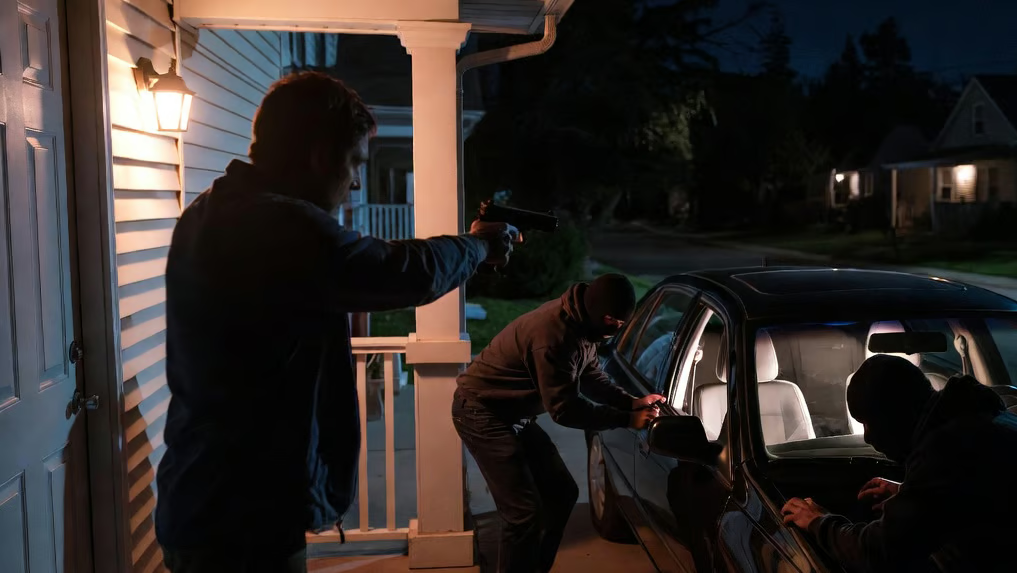
The Tennessee legislature just passed a measure that codifies a person’s ability to use deadly force in defense of property, under certain circumstances.
The measure is a significant change to current law that allows for use of force to prevent trespass or unlawful interference with property, but not deadly force solely for that purpose (unless there is a reason “as provided by law” which usually represents a threat of severe bodily injury or death).

The bill recognizes the argument that property sustains or provides the ability to sustain life (make a living) or is the result of a lifetime’s achievement.
“[If someone] was burning down your barn and you’ve only got insurance on $250,000 worth of equipment, but I’ve spent 20 years of my life building $5 million worth of whatever, if I don’t stop him and I shoot him right now, then it’s going to be on me,” Capley said. “It’s going to be on my family. I’m going to have to defend myself because a criminal came on my property and burned down my stuff. That’s not right,” said Rep. Capley, the bill’s sponsor.
On April 23, both chambers of the General Assembly passed Senate Bill 1847 (an amended version of House Bill 1802), which “…generally authorizes a person to use deadly force for the protection of property against another…” under certain situations. The measure passed on a party-line vote, 62-24-3.
The text of the final measure states that a person must satisfy all of the following caveats simultaneously before deadly force can be considered:
- the person is not committing a felony or Class A misdemeanor,
- the person is in a location where he lawfully resides,
- the person is already justified in using force,
If those conditions are satisfied, the bill imposes the following framework for use of deadly force:
(2) When and to the degree the person reasonably believes deadly force is immediately necessary to prevent the other’s imminent commission of arson, burglary, robbery, aggravated robbery, or aggravated cruelty to animals;
(3) The person reasonably believes the property cannot be protected or the other’s actions terminated by any other means; and
(4) (A) There is an imminent danger to the person or a third person of death, serious bodily injury, or grave sexual abuse; or
(B) The use of force other than deadly force to protect or terminate the other’s actions would expose the person or a third person to a risk of death, serious bodily injury, or grave sexual abuse.
The change in law addresses an all-too-common scenario where prosecutors argue that criminal activity such as home invasion, theft, or trespass are not worthy of a deadly force response, even though these activities can often quickly escalate into higher order crimes such as rape, kidnapping, and murder. Although it is a very narrow expansion to use of deadly force law, the new law slightly removes prior advantages given to criminals and places the benefit of doubt into the hands of the property owner.
The law now heads to the governor’s desk for consideration and would take effect July 1, 2026.

















Always be sure to read the fine print, or at least the actual bill language.
This took a very good original bill and legislized it through their Bessemer process to remove any restoration of Second Amendment Rights, which is par for the course.
One has to satisfy the criteria (be in fear of serious bodily injury or death) for self-defense under this bill to allow lawful use of deadly force, not to protect property as the legislature would have the simple minded think what a great move forward when in reality it changed nothing.