This weekend, we made a post on X about training, which generated some good discussion. It also made us realize that it might be a good idea to review some basic concepts about initial and ongoing training, minimum personal standards, and the realities of carrying a firearm – for new gun owners and the experienced alike.
To make this article as broad and appealing as possible, we focused on three basic questions, each in the context of what the MINIMUM personal standard should be for a civilian carrying a firearm for self-defense:
- How much time should a person practice dry firing?
- How many live rounds per month should a person shoot?
- How much time should an individual devote to training with a professional each year?
Although the author of this article is a certified firearms instructor who is actively teaching, we decided to seek the opinion of those more experienced than we are. We reached out to five individuals with whom we have close relationships. Their professional experience and backgrounds are unique, and they all have solid credentials. Below we offer their answers to these questions, followed by an in-depth discussion of commonalities and differing perspectives.

Tony – United States Navy veteran and law enforcement training officer with over 25 years of experience. Director of training for one of the largest indoor ranges in America.
- Dry fire: 15-20 minutes per day
- Live fire: 100 rounds or less per month
- Professional instruction: Eight hours annually
Micah – Head of a private security company and former instructor for the U.S. Army Special Forces / Unconventional Warfare Operations.
- Dry fire: Five minutes per day
- Live fire: 100 rounds per month
- Professional instruction: 30-40 hours annually
Rick – Retired Sergeant Major in the United States Army with 16 years of experience operating in and training Special Missions Units. Now works for a private security and training company providing weapons and tactics training to civilians and law enforcement, including SWAT and special operations.
- Dry fire: Four minutes per day
- Live fire: 50-100 rounds per month
- Professional instruction: 8-12 hours annually
Scott – Founder and lead instructor of a Tennessee-based tactics and training company. Former infantryman and paratrooper, law enforcement officer, SWAT instructor, and reserve sheriff deputy and graduate of the FBI Firearms Instructor Course.
- Dry fire: Five minutes per day
- Live fire: 50 rounds per month
- Professional instruction: Eight hours annually
Guy – Counter-terrorism and Krav Haganah combat defense instructor who has trained military groups domestically and internationally. He is also a private security professional.
- Dry fire: 20-30 minutes daily
- Live fire: 200-500 rounds per month
- Professional instruction: 16 hours / two days annually
Discussion
Carrying a firearm is a massive responsibility. It is beyond question that proficiency with a firearm is a perishable skill, and therefore demands that we take training seriously and set a personal minimum standard. Should the unthinkable happen, you will have to make life-and-death decisions in just seconds when deploying a firearm in a self-defense scenario.
Complicating all of this are legal considerations. Laws vary by state and it is your responsibility to know them. Some of us carry a firearm in conservative, red states; others are not so lucky. If you have to use a firearm in self-defense, every action will be scrutinized by aggressive prosecutors looking to bring charges for reckless or endangering actions. And they will scrutinize your entire history prior to the self-defense engagement, including your training, or lack thereof. You could also be the subject of a civil suit.
Again, our focus is on minimum personal standards, with an emphasis on the minimum. Our discussion with each of the professionals above was specifically oriented toward the average person: a single person, father, or mother with a job, a family, obligations to their church or civic group, and weekends taken up by sporting events, birthdays, and part-time jobs. We acknowledge that one reality everybody faces is how to best use limited financial resources and time.
These protocols are not designed to make a Green Beret or Navy SEAL or John Wick out of the average person. However, exceeding the standards will undoubtedly help you to be more prepared and increase the likelihood of a positive outcome in a self-defense situation in all aspects.
Myths
First, let us dispel some myths about carrying a firearm and self-defense scenarios.
You will rise to the occasion. FALSE!
You will default to your base level of training. Stress does interesting things to the body. Just one example is auditory exclusion, a temporary loss of hearing that occurs during high-stress situations. Most people do not inoculate themselves to stress by inducing it in their training. The result is that when you do face stress, everything will degrade, including coordination, gross and fine motor skills, your ability to take in information, and your ability to make good decisions.
One class will teach me everything I need to know about self-defense. FALSE!
Quite literally, every situation is going to be different, and there is no one-size-fits-all solution. Variables will include time of day, location, your state of awareness, whether you are alone or with a group, whether you are in public or private, the number of threats or threat actors, the background, the clothing you are wearing, season of the year, etc. There are so many variables that the only way to be prepared is to train based upon principles rather than highly specific scenarios.
Every self-defense scenario requires lethal force. FALSE!
Many people make the decision to carry a gun but do not consider that it is just one tool in the tool belt. However, if your belt does not have other tools or you have not prepared yourself mentally through training and the only tool you have is a hammer, everything will look like a nail. Not only is that legally dangerous, it is morally dangerous. One of the biggest advantages to training with a professional is learning and understanding non-lethal skills, beginning with situational awareness and de-escalation (“verbal judo”). And one of the most important things you might ever do is reholster your firearm without firing a shot.
Although there are many aspects of firearms ownership and training, there is a reason we focused on these three areas, which are commonly encouraged by professional instructors.
Dry Fire
Dry fire covers a wide range of skills including, but not limited to:
- Draw from concealment
- Grip
- Stance
- Breathing
- Presentation: sight alignment, sight picture, and target acquisition
- Trigger press
- Weapon manipulation and familiarization
- Malfunction drills
- Loading and unloading
- Emergency and tactical reloads
One of the most difficult things to do is draw a firearm from concealment and get it into the fight. This must be practiced and mastered, and it can only be mastered by increasing skill and proficiency through daily repetitions. Another important aspect of dry fire is that it can be done virtually anywhere, at virtually zero cost. And there is abundant free instruction available on the internet. Becoming proficient in the above skills through dry fire undoubtedly translates to increased proficiency during live fire.
Live Fire
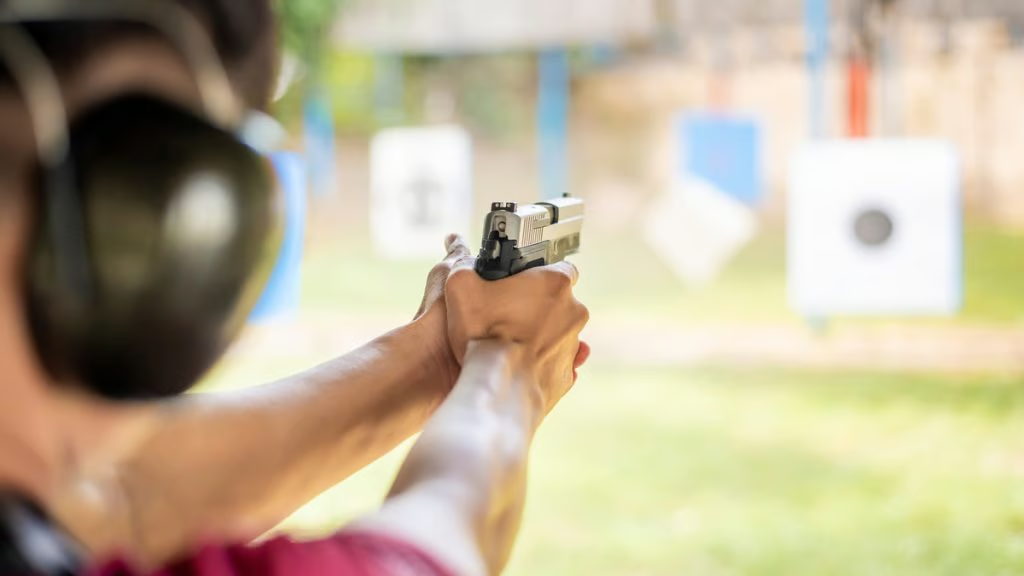
While dry fire is invaluable by itself, it does not fully replicate live fire, where an individual has to deal with the realities of live ammunition – including very loud sounds, blinding flashes of light, tactile feedback, fast-moving parts, recoil, and involuntary responses, including flinching and anticipation. The goal of live fire is to apply all of the skill sets mastered during dry fire while mitigating, adjusting for, and dealing with recoil, sight disruption, and real-world malfunctions.
Live fire can be extremely effective training when executed with a structured approach where every round has a purpose.
Professional Instruction
Just like every other skill – from bricklaying to computer coding to playing an instrument – no one person knows everything. Even firearms instructors at the highest level, including those who have trained special forces and special mission units, seek out instruction from other firearms instructors every year. A key trait they have in common is a bridled ego and a willingness to learn.
Because shooting a firearm proficiently is a perishable skill, we need reminders about the areas where we are not proficient or have developed bad habits. Another person perspective helps us see our own deficiencies, and group training helps inoculate us against stress. Professional instruction should be seen as an investment in yourself, not a burden that costs money and time.
Wrapping It Up
The goal with a personal minimum training standard is to become proficient at the basic mechanical skills at a subconscious level so that you can dedicate your brain processing power to taking in information and making the correct decisions in a self-defense scenario.
If we average out the suggestions from the professionals above, a good starting point for a personal minimum training standard – which should be achievable by the average responsible adult firearms owner – is the following:
- Dry fire: 5-10 minutes per day
- Live fire: 50-100 rounds per month
- Professional instruction: 12 hours per year
It should be emphasized that this is maintenance training. For somebody who is brand new to firearms or carrying a firearm daily for the first time, nearly every instructor recommended a more aggressive training curriculum that included three or even four professional classes in the first year.
Let us know what you think by joining the conversation in the comments section below.