On Monday, March 16, the Department of Justice filed a motion asking a Texas District Court to dismiss the case of Texas v. ATF, calling the case “moot.” The filing was signed by Brett A. Shumate, Assistant Attorney General Civil Division. But the DOJ’s admission in this brief is the very proof for why gun rights groups continue to press forward in this case.
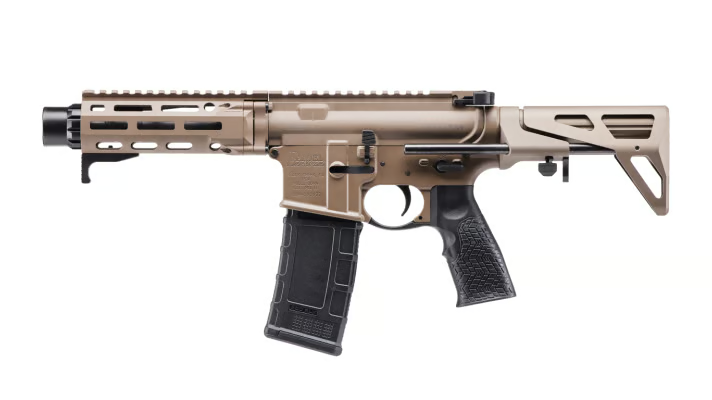
The case challenges a highly contested 2023 ATF Rule “Factoring Criteria for Firearms With Attached ‘Stabilizing Braces,'” which unlawfully changed the definition of “rifle,” using subjective criteria, compelling destruction or surrender of a firearm.
The DOJ argues that because another court vacated the rule in 2025, the case is moot. It also dismisses the challenges as “legal theories divorced from an existing final agency action.”
However, the plaintiffs in the case (the state of Texas, and gun rights groups Gun Owners of America and Gun Owners Foundation, along with a private individual) continue to press and oppose dismissal and are very clear about what they are seeking from the court: an injunction “that would prevent Defendants from enforcing the NFA’s regulations with respect to pistols with stabilizing braces.”

And with good reason: the rules – even if dismissed and no longer enforceable – can always be resurrected under a new administration. The DOJ’s aggressive denial of this request underpins a not-so-subtle hostility towards gun owners, erring on the side of protecting the DOJ rather than enumerated constitutional rights.
While at the same time claiming that the case is moot, there is no “private right of action to assert those constitutional claims,” and there is no “existing final agency action,” the DOJ also acknowledges that the DOJ itself “continue[s] to enforce the NFA’s and the GCA’s regulation of short-barreled rifles against some brace-equipped pistols…”
This admission makes the case for why gun rights groups need to continue to press for an injunction.
The original complaint can be found here.